
Industrial safety sign frame replacement can look like a simple aluminum-cutting job. The frame is only one part of the decision. Before a buyer sends cut lengths to a saw shop, someone responsible for the site must confirm the sign’s message, location, visibility, panel, mounting method, and applicable rules. A precisely cut member cannot make an unapproved sign correct.
This guide is for maintenance buyers, sign fabricators, and purchasing teams replacing an existing framed sign or preparing a repeatable spare kit. It separates sign approval from aluminum-member production, then shows what to put in a request for quotation (RFQ). It does not certify a sign design or claim that a particular saw or frame meets a regulatory requirement.
Start with the approved sign, not the saw cut list
Record the existing sign’s location and purpose. Is the whole assembly being replaced, or only a damaged frame member? Who owns the wording and symbol, color scheme, panel layout, and mounting height? If the sign is used for an accident-prevention purpose in a US workplace, the applicable provisions of OSHA 29 CFR 1910.145 belong in the site’s approval review. A fabricator’s cut drawing is not that review.
Ask the site owner to release the sign artwork and installation requirements as a controlled version. If an old sign is missing, faded, obstructed, or mounted differently from the proposed replacement, do not assume a photograph supplies the correct design. Resolve the sign specification before ordering stock or programming cuts. For outdoor or washdown locations, also identify exposure and maintenance conditions so the responsible designer can specify suitable panel, fasteners, finish, and installation details.
Choose the procurement boundary
Three purchase routes can look similar on a price list but place responsibility in different hands:
- Complete approved sign assembly: the supplier delivers the specified panel, frame, mounting parts, and identified installation information. Confirm who checks the final message and fit.
- Prepared frame or panel kit: components arrive cut and grouped for assembly elsewhere. Define who provides the panel, corner hardware, drill pattern, fasteners, and final inspection.
- Cut aluminum members only: a saw shop cuts released profiles to the buyer’s schedule. The buyer retains responsibility for the sign design, joints, panel fit, assembly, mounting, and approval.
Do not compare the price of four loose cut lengths with the price of a finished sign as if the deliverables were equivalent. Compare the same boundary, revision, packaging, quality checks, and handling of exceptions.

Build a release package a fabricator can actually quote
Give every frame member a part number, profile designation, quantity, material and finish requirement, nominal length, end condition, and drawing revision. Supply a cross-section drawing of the extrusion or an approved physical sample; the term “standard sign frame” is not enough to identify the section. The Aluminum Association’s extrusion drafting guidance is useful context for communicating profile geometry, but it does not approve an individual sign system.
Show how the panel enters or attaches to the frame. Identify panel thickness, edge allowance, retaining feature, corner connector, screw or rivet location, and whether the members require mitered, square, drilled, or notched ends. Mark which surfaces are visible after assembly. If a sample sign exists, record whether it is an approved master, a dimensional reference, or merely an old item awaiting design confirmation.
Industrial safety sign frame replacement: check the joint and panel fit
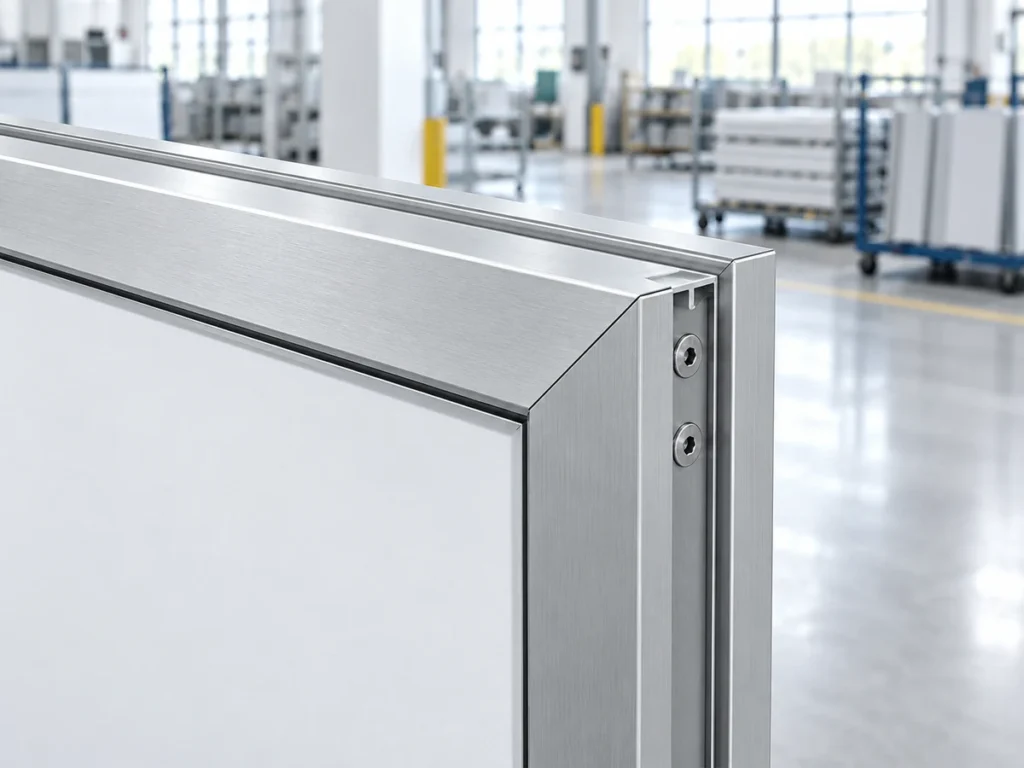
A sign frame can fail at the interface even when each individual cut length matches its drawing. On the first approved assembly, check the diagonal relationship, panel seating, corner gaps, connector engagement, fastener access, and the way the mounting points carry the assembly. Do this with the specified panel and hardware, not with bare frame pieces alone. Record the acceptable method of checking rather than inventing a universal dimensional tolerance for every profile.
For a replacement of an existing sign, compare the new assembly against the approved reference and the actual mounting location. If the wall, post, or bracket has changed, send the issue back to the person who approves the installation. A cut shop should not infer a new fixing pattern from a photo. Where the frame is visible, agree which scratches, burrs, finish marks, and corner appearance are unacceptable before the batch is cut.
Decide whether sawing in-house is the right boundary
Cutting in-house may make sense when the site already owns the extrusion stock, approved drawings, suitable clamping and cutting equipment, trained operators, and a repeatable inspection method. Outsourcing may make more sense when demand is intermittent, the profile requires a dedicated fixture, a finished kit is needed, or the supplier must manage traceable revisions and packaging.
Ask a potential cutting supplier to explain how it will support the profile without crushing visible faces, control miter orientation, separate left-hand and right-hand parts, deal with burrs, and protect finished surfaces in transit. Request a sample assembly or a limited first article before a large repeat order. The supplier’s video or machine brochure can show a general cutting process; it cannot prove that this exact profile, joint, or installation will work without a relevant trial and inspection plan.
Video context: The following Jiurun Machinery channel clip shows general aluminum-cutting equipment footage. It is an equipment/process example only. It does not show or validate this safety-sign material, frame profile, model configuration, customer order, trial cut, dimensional result, sign design, or performance.
Specify the handoff and what happens when an old sign differs
A useful purchase order states the released drawing revision, part numbers and quantities, packaging unit, label content, inspection records, and recipient of change notices. For multi-location work, put the site or sign ID on each kit so frame members do not become anonymous lengths. Separate replacement spares from newly designed signs in the order. The replacement route should identify who decides whether a corroded bracket, altered panel, or obsolete artwork triggers a new design review.
If the installed sign differs from the approved reference, stop that item and raise a discrepancy. Document the actual condition and ask the sign owner for a disposition. Do not quietly shorten members, enlarge holes, or substitute a profile because the assembly appears close enough. Small changes can affect panel retention, visibility, mounting, and the traceability of future replacement kits.
RFQ release checklist. Before requesting a price, confirm the sign owner and approved artwork; panel and frame drawings with revisions; extrusion section and finish; member schedule and end details; corner and mounting hardware; first-assembly inspection; visual acceptance; labels and packaging; and who resolves site discrepancies. An incomplete package is a reason to request clarification, not a reason to guess a machine tolerance.
Questions to ask before awarding the work
Can we replace only one side of an old frame? Sometimes, but first confirm profile compatibility, finish, panel retention, connector fit, and condition of the remaining assembly. A visually similar section can have a different channel or corner interface.
Should the saw supplier approve the sign? Only if that responsibility is explicitly within its contracted scope and it has the necessary design authority. A shop that cuts released lengths cannot independently approve wording, placement, or workplace compliance.
What should a first article prove? The first article should answer the agreed fit and assembly questions using the specified panel, joint hardware, and mounting interface. Its inspection record should identify the drawing revision and any approved deviations. It should not be treated as proof of every future installation.
What information helps JiurunCut discuss a cutting process? Send the released aluminum profile drawing or physical section, size range, end-cut geometry, finish constraints, estimated quantities, and the intended inspection approach. We can discuss suitable cutting and handling questions around that material. Final sign design and site approval stay with the responsible parties. Contact JiurunCut with the profile and application details for a process discussion.