
Industrial workbench height change starts with a task and a released station design, not with a saw setting. A bench that feels too high for one operation may still be correct for another operator, fixture, chair or material-flow step. Lowering four aluminum supports might appear inexpensive, but it can change knee clearance, shelf and tool position, guarding, cable routing and the way the top is supported. A saw can prepare approved profile members; it cannot approve the reconfigured workstation.
This buyer guide compares three supply routes: order a complete height-adjustable or differently sized workstation from the system maker; use a maker-approved reconfiguration kit for an existing modular bench; or commission newly cut aluminum supports to a released design. The right route is the one that produces a usable station at the agreed handoff, with the responsible owner able to inspect it. None of the illustrative images or general machine footage below documents a specific customer station or proves its capacity, stability or ergonomic result.
1. Industrial workbench height change starts with the task
Record the actual operation, product, tools and working posture. Is the station used for standing assembly, seated inspection, packing, microscope work, lifting into a fixture, or several of these? Identify the operators and shifts, the workpiece range, the top and fixture thickness, and the positions of frequently used tools. A desired top height alone is not an adequate purchase specification. The work may need an adjustable range, a different top or fixture height, a stool and foot support, or changed material presentation rather than shorter frame posts.
Use an ergonomic review led by the employer and the people who operate the station. Bosch Rexroth’s production-workstation ergonomics guidance discusses body and working height, equipment adjustment and planning aids. OSHA’s work-height and angle guidance for production workstations explains why a suitable work surface should reduce awkward bending and raised arms. These are planning references, not universal dimensions for a particular bench. Record the task and observe the operators before setting the target.
Photograph the existing bench from all sides and identify its manufacturer, profile system, part numbers and revision. Mark the top, rails, legs, cross-braces, leveling feet, drawers, bins, electrical outlets, lighting, tools and any attached guard or fixture. Note the floor and anchoring condition. A change to one leg set may alter the relationship among several attached systems. Capture the original assembly instructions and approval before purchasing parts.
2. Compare three routes at the same completed-station handoff
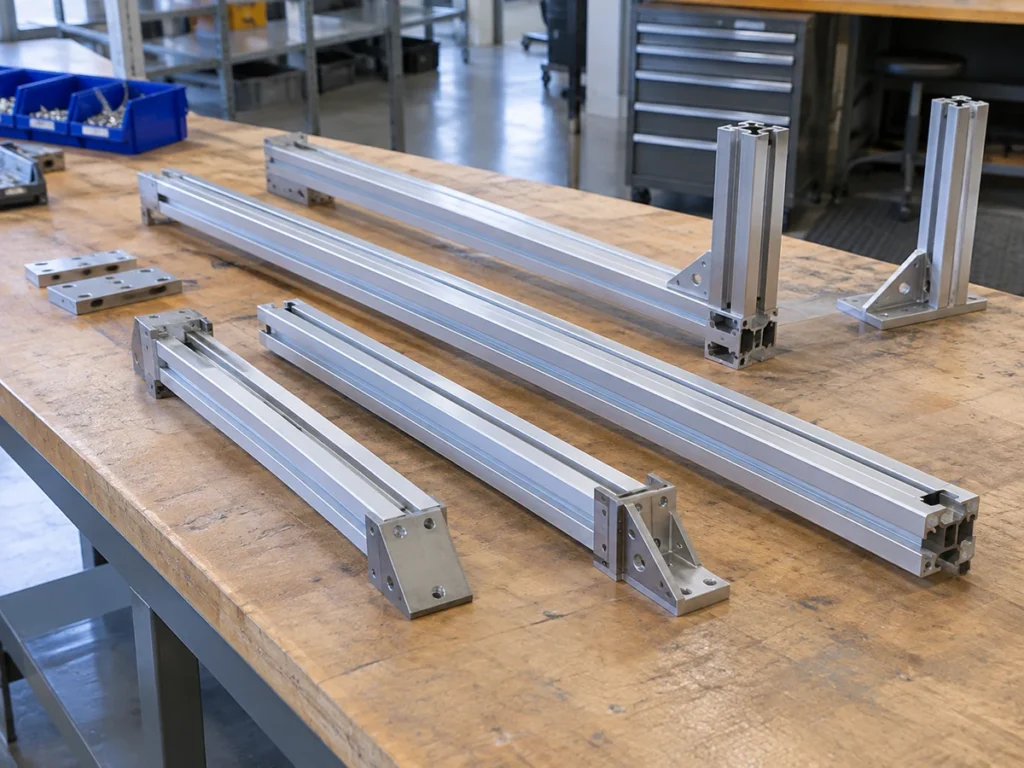
Route A: buy a complete station or approved adjustable system
Choose a complete system when several people or jobs require different working heights, when the existing frame is not approved for modification, or when its accessories and loading cannot be requalified economically. Compare the actual supplied station, not a bare lifting column: top size and material, adjustment mechanism, allowed load and motion conditions, stability requirements, controls, power, foot clearance, accessories and installation. Item’s electric height-adjustable table-frame example shows why the mechanism and its rated frame belong to a specified product, rather than a loose extrusion cut. Its published values apply to that product only.
Route B: use a maker-approved reconfiguration kit
If the present station is modular, ask its manufacturer or responsible designer for a released alternative height or conversion package. The kit may include new support members, joints, braces, feet, fasteners and revised assembly instructions. Verify that the top, fixtures and overbench structures remain supported in the approved configuration. Obtain a drawing or bill of materials linking each new part to the exact frame family and revision. A kit’s price may look higher than four pieces of profile, but it can include the interfaces and instructions required to complete the change.
Route C: prepare new supports to an approved custom design
A qualified owner may permit separate aluminum members when a released drawing defines the target configuration and the remaining work is genuinely a profile-cutting package. The supplier should quote the exact stock profile, material and finish, cut lengths, end geometry, holes or threads if any, and the receiving condition. Separate saw cutting from drilling, tapping, joining, wiring, assembly and final station approval. Do not shorten installed legs on the assumption that all members are interchangeable; even identical-looking sections can differ at joint, slot, brace or foot interfaces.
Normalize each route to a station ready for the same receiving owner. Add the costs of disassembly, new parts, missing connectors, inspection, reassembly, downtime and rejected samples. A complete adjustable bench, an approved conversion kit and loose saw-cut uprights are different outputs. Compare lead time and total accepted station cost at that common handoff, while keeping the design and operator acceptance decisions with the responsible parties.
3. Release a support-member package before a saw trial
For Route C, prepare a member schedule tied to the workstation ID and drawing revision. Include each profile part number and section, alloy or stock specification, finish, raw-stock condition, quantity, finished length, datum, end orientation and any protected faces. Identify left and right members where they differ. A cut list should also locate slots, connector access, foot plates, braces and the top interface. If a later process creates holes or threads, name it and give it its own drawing and inspection step.
Measure from a defined datum, not from a photograph of the old station. The owner should approve how the desired working surface relates to top thickness, feet, floor condition and attachments. A nominal height change cannot be converted automatically into the same reduction on every upright. Verify that the proposed design retains required clearance for the operator and room for drawers, tools, cable loops and material transfer. If an adjustable product is used, include both ends of its intended range and the interfaces throughout travel.
The saw trial should use the authorized profile and the most demanding member in the retained cutting package. Agree the datum, end condition, length checks, surface-mark criteria and sample count before the cut. Inspect actual pieces against the released drawing; a machine feed-position figure is not a finished-support accuracy claim. Ask for both an accepted sample and a record of any rejects. The cutting supplier can demonstrate a relevant preparation step, while the station owner verifies the assembled result.
4. Check the joints, accessories and station release
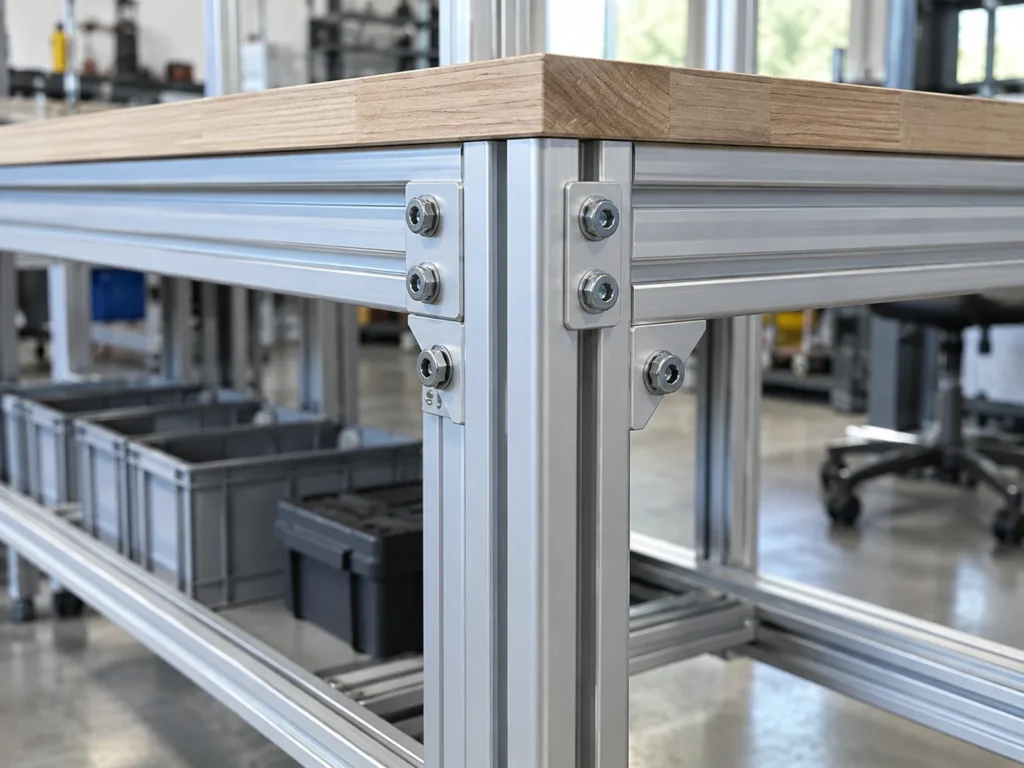
The top corner, upright and cross-brace connections determine whether a new support can be installed as specified. Review access to fasteners, insert engagement, brace positions and the route of any cables or air lines. If the bench carries a shelf or overhead frame, the owner must assess that structure at the new height. The illustrative joint image below helps identify the inspection boundary; it is not a drawing, load test or approval for another workstation.
Plan a dry assembly or first-station build before a full purchase. Confirm fit of the top, attachments and leveling feet, then check stability and clearances under the owner’s acceptance procedure. Moving a work surface can change reach to bins and tools or create awkward postures even when the aluminum pieces fit. Record operator feedback at the intended task, and document any corrective changes before releasing the configuration to repeat production.
Do not assume that a saw supplier certifies the entire station. The responsible employer, machine builder or system maker must decide whether the change affects load rating, electrical work, guarding, lifting equipment or other approvals. Those decisions belong in the station work package with named reviewers. The saw quote should state its limited output and exclusions.
General aluminum-cutting equipment footage
The following video from Jiurun’s own channel shows general aluminum-cutting equipment in operation. It is an equipment example only. It does not prove the workbench material, approved profile or support design, exact saw model configuration for this job, a customer station, a height-change trial, accuracy, capacity, stability or ergonomic performance.
5. Send an RFQ that produces comparable answers
Give each respondent the existing station identity, current and desired task, released design or requested design-review owner, profile family, quantity and forecast, work-height requirement, top and accessory inventory, installation responsibility, required receiving point and acceptance method. Ask the system maker for a complete station and an approved conversion option. Ask a member supplier for prepared supports to a released drawing. Ask a saw supplier only for the authorized aluminum cutting work and a representative sample plan.
Require each quote to identify the exact deliverable, exclusions, stock and drawing revision, included joints and hardware, expected lead time, sample and inspection evidence, and who resolves a mismatch. If one route assumes that the buyer supplies a drawing and another includes engineering, show that difference explicitly. If the proposed profile, connector or adjustment mechanism differs from the released system, obtain the responsible designer’s review before ranking bids.
Decision rule: choose a complete adjustable station when the work needs range or the original bench cannot be safely reconfigured; choose an approved conversion kit when the system maker has a released alternative; consider cut-to-drawing supports only when a qualified owner approves that specific configuration and accepts the assembled station. The lowest price per aluminum cut is not the completed workstation cost.
For an eligible aluminum-support cutting package, see JiurunCut’s aluminum profile cutting machines and send the released member drawing and trial requirements. Include profile sections, length mix, quantity and acceptance owner. We can discuss a suitable cutting configuration and sample; workstation design, installation, load approval and ergonomic release remain with their qualified owners.