
Appliance structural frame supply is a make-or-buy decision before it is a saw specification. A manufacturer may receive complete frame assemblies, prepared member sets, or long extrusions that it cuts in-house. Those routes deliver different work, risk, and inventory to the assembly line. The decision only applies to product families whose released drawings and bills of materials actually contain eligible aluminum extruded frame members. A photograph of a frame, or a finished appliance’s outside dimensions, cannot establish the material, section, or cutting requirement for your product.
Define the accepted frame, then the metal work you retain
Start with the assembly that the next operation will accept. Is the buyer supplying an appliance chassis, a mechanical frame module, a matched set of cut members, or individual blanks? Write down the receiving owner and the release evidence for that stage. Keep covers, sheet panels, brackets, fasteners, wiring, controls, and finished appliance approval separate from the saw’s work. A saw can prepare eligible stock ends; it does not deliver a qualified appliance.
For each released model and revision, build a member register. Record the member position, approved drawing and stock identity, incoming length and finish condition, required blank faces, later features, quantity per accepted frame, and the party that checks the part. Distinguish a frame’s outside size from a member’s cut datum. A product dimension does not automatically become a saw setting. Keep a separate line for purchased frame assemblies and service parts so that retained cutting demand is not inferred from all finished-unit sales.

Compare three appliance structural frame supply routes
Buy complete frame assemblies. The supplier carries the cut, subsequent features, connection, and assembly work within the agreed frame specification. The appliance maker still owns receiving checks, model identity, and the integration of that frame into its finished product. Ask what is included: a bare assembled frame is different from a frame with panels, brackets, or preinstalled hardware. This route can reduce in-house fabrication steps, but it transfers more of the change-control and lead-time dependency to the supplier.
Buy prepared member kits. A supplier cuts and, where agreed, adds downstream features before shipping a model-specific set. The buyer retains frame assembly or integration. The purchase order should define whether parts arrive loose, labeled by position, grouped by frame, or with independent spare pieces. A kit is useful only if missing and held members can be identified before the next operation. Do not compare its piece price with raw extrusion until both offers reach the same accepted handoff.
Buy long stock and cut retained members. The appliance maker takes responsibility for incoming extrusion identification, stock storage, support and clamping assessment, cutting, cut-piece identification, verification, and the remaining work needed to reach an accepted set. The attractive unit price of stock does not include those activities. This route may suit stable, recurring member families or controlled late changes, but only if the released geometry and the actual eligible stock can be processed on the quoted configuration. A mixed route can assign some frame families to a supplier and retain others in-house; it must state the split explicitly.

Put every quotation at the same receiving stage
Choose one comparison stage, such as a released, labeled and accepted member set at the frame-assembly station. For a complete-frame offer, separate the supplier’s finished-frame price from work the buyer would otherwise perform. For a prepared-kit offer, include purchased members, features, kit control, freight and receiving inspection. For retained cutting, include stock purchase, yield and usable remnants, people, handling, tooling and consumables, verification, held-piece routing, subsequent machining or joining, and capacity during model changes. Count only released volume that actually uses the retained aluminum members; purchased variants and non-extruded components should not inflate saw demand.
Model an ordinary production week and at least one credible change case. Compare the same model mix, accepted output, shift window, and downstream responsibility for each route. A low cost per cut is irrelevant if the kit is incomplete when the frame line needs it. Likewise, a complete-frame quote may be preferable for a low-volume variant even when the recurring main family is cut in-house. The decision can differ by family without requiring a universal factory-wide answer.
Separate extrusion condition from saw capability
An approved profile drawing must describe the incoming section and the faces that can be located and supported. Hollow and open sections can differ in contact, rigidity, surface protection, and datum choice. The Aluminum Association explains that extrusion fabrication commonly begins with cutting and may continue through punching, machining, bending or welding; those later operations must be priced and assigned rather than silently credited to a saw. Its extrusion-tolerance guidance also treats profile dimensions, straightness, twist, and flatness as separate characteristics. A quoted feed-position claim is not a promise of finished frame fit or final appliance accuracy.
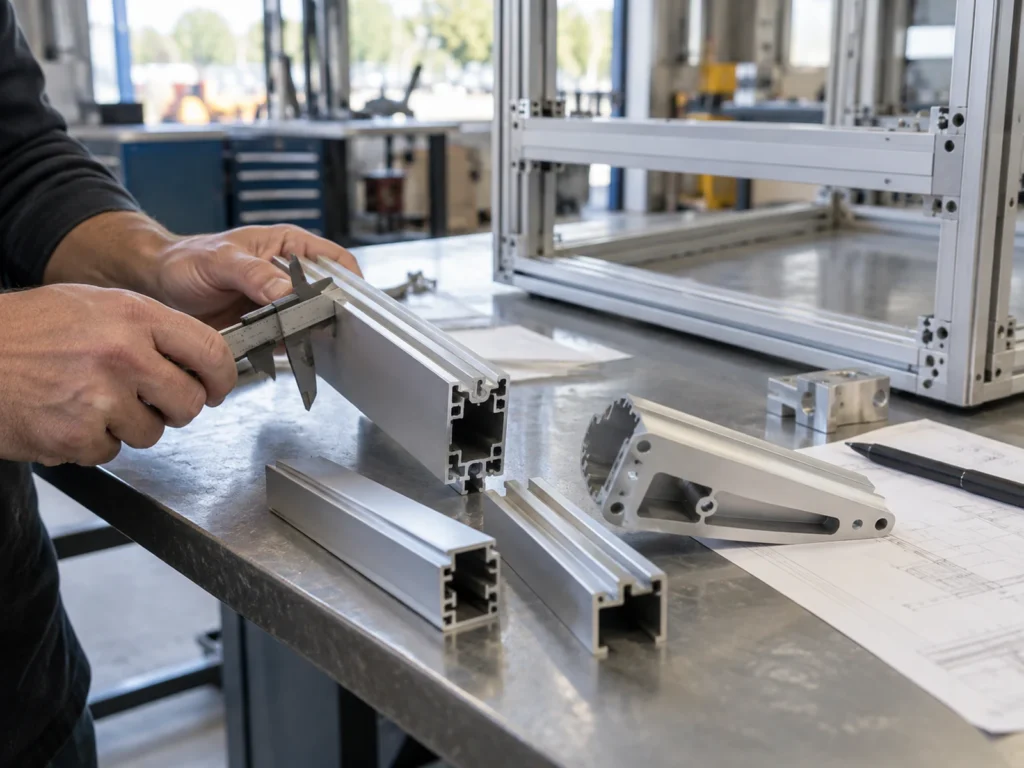
When asking a saw supplier to assess the job, provide representative physical stock and the released drawings, not a generic product photo. Identify the actual section, finish, length range, exposed faces, cut end requirement, support constraints, changeover frequency, chip and burr acceptance owner, and how a cut piece is handed to the next station. Request an evaluated configuration and a bounded trial plan. Do not assume one machine handles every appliance frame family simply because one sample is aluminum.
Verify a complete member set, not one attractive cut
A useful trial includes the different eligible profiles and stock conditions that drive the decision. Agree beforehand which family members and positions will be sampled, what measurements or assembly checks are needed, and who accepts the results. Observe how the offered setup locates and supports the section, protects visible surfaces, controls the cut end, and identifies the finished member. Measure with the buyer’s approved method. Then check the released member set at the next handoff, including any required downstream holes, joints, or surface operations that remain outside the cutting machine’s scope.
Separate a machine demonstration from production qualification. A video of a different profile being cut shows equipment motion, not the acceptance of your appliance frame. A passed blank-length check does not certify a panel opening, corner fit, mechanical function, electrical system, or finished appliance. Record gaps as open supplier or buyer actions. The accepted trial should lead to a clear configuration and responsibility schedule, not an unsupported guarantee.
Protect model and service-part identity
New-build production and later spare demand need separate forecasts. Appliance model, revision, part position, finish, and supplier identity should remain connected to each accepted member or kit. Public spare-parts systems from Bosch and GE Appliances ask for a model number and show part diagrams or assembly sections; they illustrate why a generic shape or an outside dimension is insufficient to declare interchangeable service stock. They do not establish the bill of materials for your products. Use your own controlled parts records for substitution and service release.
For low-volume service demand, compare storing accepted spare members or complete frames with cutting from retained stock when an order arrives. Include the cost of maintaining the correct drawing, fixtures, material, finish route, inspection authority, and packaging after a production model changes. If the original extrusion or connector is no longer available, the decision belongs to the product owner; a saw purchase alone cannot approve a replacement design.
What the RFQ should request
- The released model and revision mix, with a separate list of eligible aluminum members and bought-in assemblies.
- Incoming stock drawings and actual samples, including finish and visible-face handling requirements.
- The accepted output stage: blank, prepared member kit, or assembled frame, with explicit exclusions.
- Representative trial pieces, measurement and set-receiving criteria, decision owners, and treatment of held pieces.
- The quoted cutting configuration, loading and support, changeover method, auxiliary equipment, service scope, and site interfaces.
- A like-for-like cost comparison over the same accepted frame volume and review period, including remaining work and supplier risk.
Ask suppliers to identify assumptions that depend on your actual drawing, sample, and available machine package. Do not insert a universal tolerance, throughput, or material guarantee into the RFQ without a released requirement and a verified configuration.
General equipment footage
The Jiurun video below is a general example of aluminum cutting equipment and feed/guard movement. It does not show the appliance frame materials, model configuration, customer, sample trial, fit, or performance discussed in this article.
Make the supply decision before ordering
Keep complete frames, prepared kits, and retained stock on one stage-by-stage decision sheet. Approve the retained member portfolio and receiver first; then ask whether the assessed saw closes a real capacity or control gap at acceptable total route cost. If the decision is still split by product family, show the split in the investment case. To discuss an actual eligible extrusion and the available machine configuration, review Jiurun’s aluminum profile cutting machine and send the released drawings and representative stock for a scoped inquiry.
Source context: The Aluminum Association, Processing 101; The Aluminum Association, extrusion tolerance overview; Bosch Home Appliances, model-specific parts finder; GE Appliances, parts lists and assembly diagrams. These sources support the general process and parts-identity distinctions; they are not evidence for a Jiurun configuration or this manufacturer’s released design.