
Buying an aluminum saw for door manufacturing starts with a supply decision, not a blade diameter. A door factory may cut frame and leaf profiles from long stock, receive a prepared member kit, or purchase an assembled door. These routes have different cutting workloads and different acceptance points. Before asking for a machine price, define which physical members your factory will actually retain, in what condition they arrive, and what a complete accepted delivery means.
For a useful quotation, send one released door-system bill of members and a representative order mix. Separate the cut blank from the finished frame, leaf, threshold, glazing, gasket and hardware. A saw trial can demonstrate a defined cutting step; it cannot establish the performance of the completed door. The practical test is whether the proposed equipment produces the right accepted member sets at the required handoff, with the labor and remaining operations made visible.
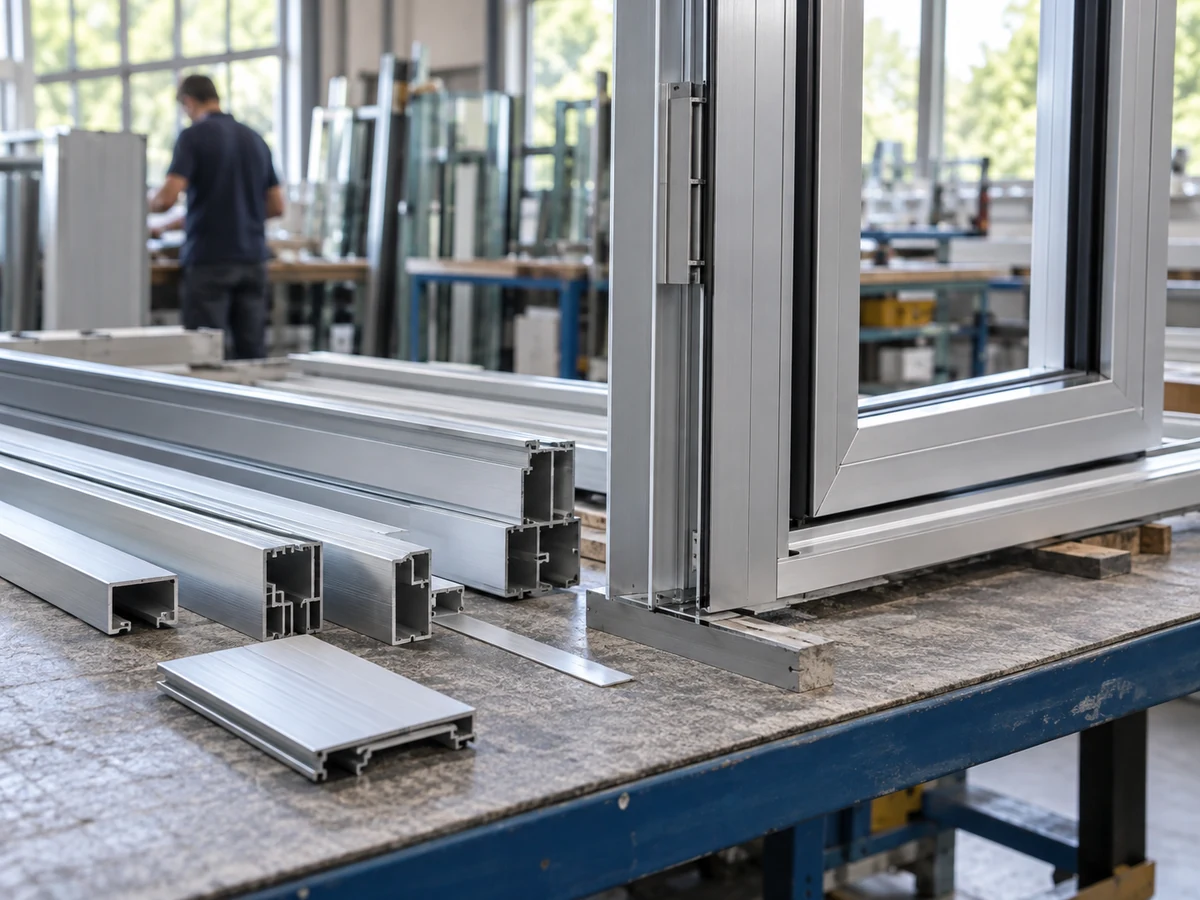
The header image is an illustrative installed aluminum-frame scene. It is not evidence of a Jiurun customer, an actual cutting trial, or the equipment route discussed below.
First choose the supply stage that the saw must serve
Map each order family to one of three routes. In a bought-door route, a supplier delivers an assembled unit; in-house sawing may be limited to approved trim or replacement members, or may be unnecessary. In a prepared-kit route, a supplier cuts and labels the frame and leaf members, while your factory assembles the door. A new saw is justified only for the specific member work that remains. In a retained stock-to-member route, your factory receives approved long profiles and performs the released cuts before subsequent machining, assembly and inspection.
Do not count all finished doors as saw output if some are purchased complete. Likewise, do not assume that a powder-coated, thermally broken, or fitted member arrives as a plain extrusion. Confirm the actual supplied condition for each profile family before discussing clamps, support and cutting sequence. A door system can combine frame and leaf profiles with separately supplied infills, gaskets, thresholds and hardware. Schüco’s AD UP Design Edition fabrication information, for example, explicitly distinguishes profiles, door infills, gasket corners and threshold solutions; it is system context, not a specification for a Jiurun machine.
Release a complete frame-and-leaf member list
A door opening size does not tell a saw supplier which pieces to cut. Ask the system designer or fabricator to release a member schedule by system, revision and door hand. Record the outer frame members, active and inactive leaf members where applicable, any eligible transom or reinforcement profiles, and any threshold or trim that is actually cut from approved stock. Mark each item as in-house cut, bought prepared, or outside saw scope. Keep the approved section drawing beside the item rather than substituting a photograph of an installed door for the material definition.
For each cut member, give its input stock length, profile section, material and finish condition, required blank length, end form, visible-face orientation and downstream receiving point. Identify whether the drawing dimension is a physical blank, a post-machining member, or an assembled-door reference. The accepted cut-end datum and inspection method must follow the released drawing and receiving process. If the supplier has not confirmed these, ask for a trial proposal rather than a guaranteed finished-door tolerance.
The distinction matters commercially. Reynaers’ aluminium-door environmental product declaration describes profile preparation by sawing and milling before frame assembly, followed by gaskets, infills and hardware. That sequence is a useful reminder to keep the saw-stage evidence separate from later fabrication and door qualification. It does not mean every door maker performs every step in-house.
Use the released job mix to compare machine routes
Compare a staffed single-head route, a two-end cutting route, and a programmed feed route only against the actual member list. A single-head workflow may suit mixed short runs when handling and changeover dominate; a two-end workflow may warrant a trial where released paired ends and repeat lengths justify it; programmed feeding is relevant only where the approved stock, end geometry and batch pattern support it. These are questions to test, not promises that one machine type is best for all door work. JiurunCut’s machine overview provides the broad equipment directions; the application drawing and quote must settle the specific configuration.
Ask the supplier to show how the longest approved profile is supported before the cut, how finished members leave the station, and how left- and right-hand door parts remain identified. Include the smallest approved section and any delicate finished face in the trial. Check whether a changed profile requires new contact pads, stops or programming, and count that setup in the same production period as the quoted output. If the quote includes a feed rack but excludes unloading or sorting, the apparent machine cycle is only part of the route.

Build a trial around accepted door-member sets
Request a representative trial with the actual approved material, or clearly label any substitute stock and the limits of what it can prove. The sample should cover the profile families and finished-face conditions that drive the purchase decision, including a changeover between two real jobs. Record the input identifier, machine configuration, fixture contact, cut program or stop setting, operator interventions, rejected pieces and accepted member labels. A photograph of a single clean cut is not a complete trial record.
At the saw exit, inspect length and end form against the correct physical blank references. Record visible-face marks and burr or chip conditions using criteria agreed with the downstream receiver. Then pass a complete, identified member set to the next operation for fit or assembly checks under that team’s procedure. A dry fit may expose a hand, orientation or kit-content error, but it cannot by itself certify water tightness, thermal behavior, security, glazing integrity or installed-door compliance. Keep the cut-stage, assembled-frame and finished-door approvals as separate decisions. For drawing-level cut questions, see the existing door-frame cutting drawing checklist.
Compare quotes at the same accepted output stage
Ask every bidder to price the same released member portfolio and the same receiving point. Include material handling, infeed support, fixtures, tooling, operator attendance, changeovers, inspection, labeling and outfeed. Add the work that remains after sawing: profile machining, finish protection, assembly, bought components, verification and any external processing. If one quote ends at loose blanks and another includes prepared kits, normalize the comparison before interpreting a lower machine price as a lower cost per accepted door package.
A simple worksheet can help: count the accepted frame-and-leaf member sets delivered during a stated production period, then divide the period’s relevant labor, consumables, material loss and equipment cost by that accepted count. Keep purchased complete doors and replacement-only jobs separate from new stock-to-member production. Use measured trial observations and your own order forecast; do not insert a supplier’s generic cycle-time figure as if it were your factory’s completed-door throughput.
What to send with an aluminum saw for door manufacturing inquiry
- Released system and revision, with a member list that separates frame, leaf, threshold, trim and non-saw items.
- Approved section drawings and actual input condition for each retained profile, including finish and any combined material state.
- Blank drawings, end forms, visible-face rules, quantities by family, and left/right or other hand identifiers.
- Stock lengths, receiving stage, downstream operations, inspection method and complete-kit labeling requirement.
- A representative mix of repeat orders and changeover jobs, plus the labor and material-handling boundaries to include in the quote.
- The required trial record and acceptance criteria, with finished-door approvals assigned to the appropriate downstream team.
Send this package through JiurunCut’s engineering inquiry page and ask for a configuration proposal and sample-cutting plan against the released members. If the input condition or assembly datum is still unsettled, state that gap openly. A qualified proposal can then identify what can be tested now and what must wait for the approved door-system documents.
General equipment video
Video: general angle-saw equipment footage from the Jiurun Machinery YouTube channel. It illustrates a machine workflow only; it does not prove this article’s door material, model configuration, customer, trial, cut quality or performance.