
Mixed aluminum extrusion saw purchases become difficult when a factory expects one cell to process both delicate sections and reinforced, multi-cavity members. The question is not whether both shapes can be placed near the blade. It is whether the quoted machine, support and handling arrangement can produce accepted parts from both families after a real changeover, at a rate and cost that fit the order mix. A catalog envelope can help shortlist a saw, but it cannot approve contact on a thin wall or the end geometry of a larger member.
This guide is a buyer’s trial and quotation framework. The photos below illustrate different profile and fixture questions; they are not samples from one customer test. JiurunCut’s machine overview distinguishes CNC length control, semi-automatic handling and other routes. The manufacturer catalog is a starting reference for model discussion. Request the exact delivered configuration and test your released drawings before committing to one shared cell.
Mixed aluminum extrusion saw: define both part families
Build a short schedule for each family. Record profile drawing revision, alloy and temper if relevant, stock length and condition, cross-section, smallest supporting contact area, finished length, angle, visible face, batch size, and the next operation. Mark the dimension datum and how the finished part will be inspected. A delicate extrusion may have a thin flange, fin or unsupported lip. A reinforced member may have multiple cavities, internal ribs and a larger handling mass. Those descriptions are screening questions, not a claim that every member in either family behaves alike.
Include the extremes the cell will actually see. The smallest thin section, the widest reinforced section, the shortest accepted part and the longest stock may stress different parts of the process. Do not choose only the easiest photograph or a single nominal cross-section for the trial. If the production route includes mirrored ends, varying angles or finish-critical faces, include those variants explicitly. Ask who owns the drawing revision list so a later design change does not silently inherit a prior approval.
Map the stock path and contact surfaces
Start at the infeed, not at the blade. For each family, show how stock is presented, supported, located, clamped, cut, released and removed. Note rollers, tables, stops, nests, pads, side guides and outfeed supports. A long reinforced section can need a different support span and safe handling plan from a short delicate member. A thin wall can be distorted by a poorly placed contact even if the saw’s nominal capacity is ample. The supplier should show each actual contact point on a marked section drawing and explain how operators identify the correct orientation.
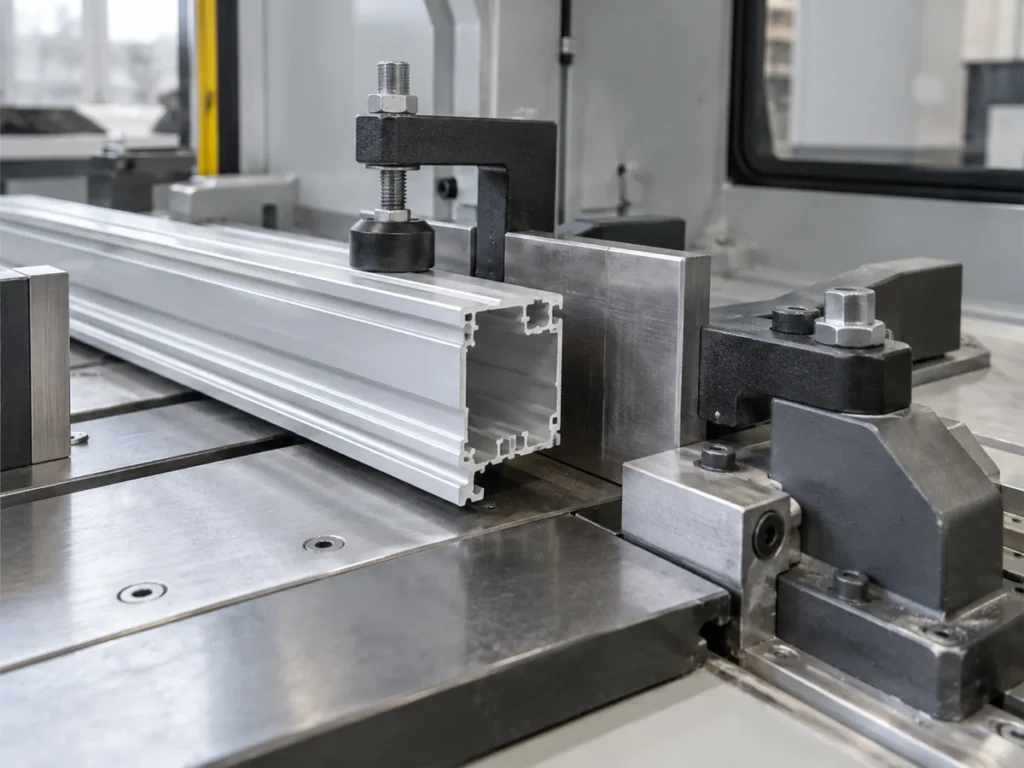
Do not infer hold-down force, finished-part accuracy or cycle time from a clamp photograph. The thin-wall clamping guide addresses contact questions for one vulnerable section; the shared-cell decision adds a second family, its changeover and the economics of accepted output. Ask whether pads, nests or stops are dedicated, adjustable or interchangeable. If a contact set must be changed, define the tools, approval method, storage and time involved. A configuration that works only after an unquoted fixture is installed is an incomplete offer.
Separate blade suitability from whole-cell suitability
Blade specification matters, but it is only one part of the buying decision. Ask the supplier to name the blade type, diameter, bore, tooth form and operating setup proposed for each family, and whether one released blade arrangement is claimed to cover both. If the blade changes, include the swap, setup, first-piece inspection and used-blade control in the changeover. If it does not change, test both families under the same declared blade condition. A good cut on one section does not establish that the other is acceptable.
The existing mixed-profile blade trial focuses on whether one blade can serve a job mix. This review asks the wider question: can one complete saw cell, with its handling, fixture and inspection method, serve both part families without hidden changeover costs? Record blade findings separately from movement, clamping, marking, burr, dimensional results and operator interventions. That makes a failed sample diagnosable rather than turning every defect into a blade purchase.
Run a paired trial with a return changeover
Agree acceptance criteria before stock reaches the machine. For each family, specify the released drawing, datum, finished length and end geometry limits, surface condition, burr and handling requirements, measurement tools, sample count and who signs the record. Require the supplier to document the actual saw model, blade, fixture, support, controls and operator steps used. A feed-positioning figure, if quoted, is not a finished-part tolerance. Measure the accepted parts by the agreed drawing method.
Run the delicate family first, then the reinforced family, then return to the delicate family. This A–B–A order exposes whether the second setup can be reversed without lost settings, contaminated contact pads or an undocumented reference change. Repeat the order in reverse if the production plan often starts with the reinforced stock. Keep rejected parts and causes in the record. Record total elapsed time from stock presentation through accepted-part handoff, not merely blade time. Include setup, first-piece approval, loading, cutting, removal, inspection and any rework.
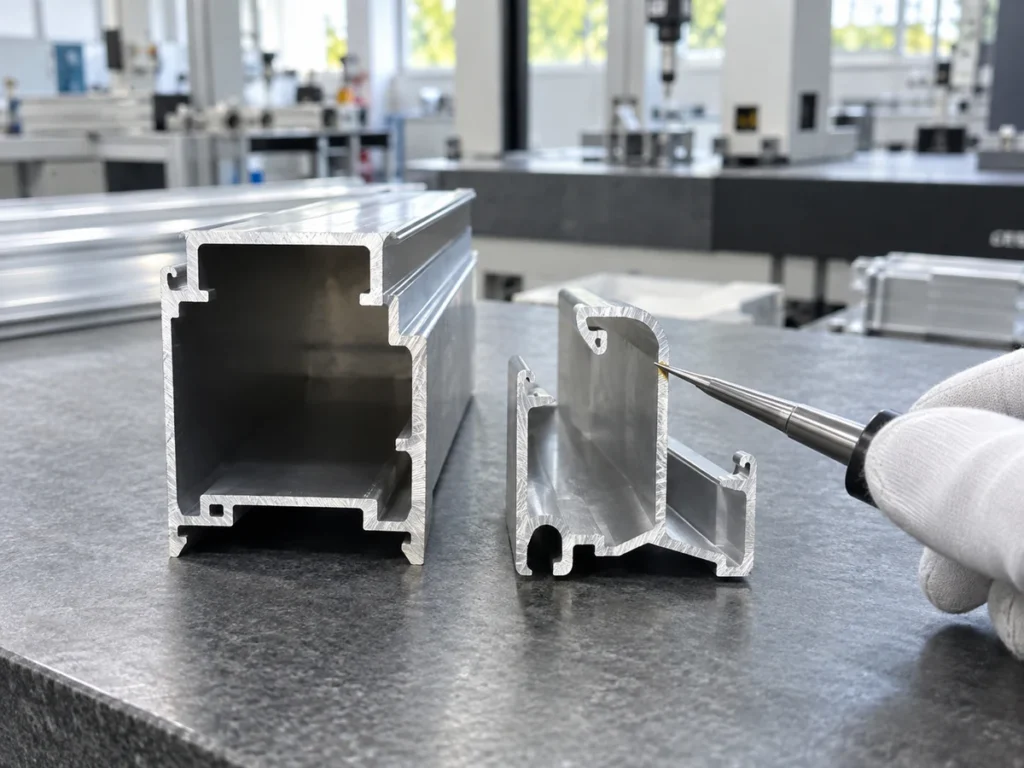
If one family passes and the other does not, resist a generic “machine passed” conclusion. Identify the failing drawing row and whether the cause is support, locating, contact, blade/cut conditions, length reference, measurement or discharge damage. Retest the changed element on both families when it can affect both. A local fix for a delicate lip might narrow clearance for the reinforced member; a wider stop for the large section might change the small part’s datum.
Compare the one-cell route with two honest alternatives
Prepare three quote routes for the same accepted part schedule: one shared cell with documented changeover; two dedicated cells if the families run concurrently; and purchasing prepared parts or outsourced cuts for the intermittent family. The objective is not to make the shared saw win. Compare included equipment, fixtures, floor space, utilities, staffing, maintenance access, changeover labor, accepted throughput, rejects, outside lead time and spare capacity. Do not compare a fully equipped two-cell quote with a bare shared machine price.
A shared cell can be attractive when batches are large enough to absorb a known changeover and the production calendar allows both families to use it. It can be a poor purchase when urgent orders overlap, changeover repeatedly consumes the shift, or one family requires an unquoted special arrangement. Two cells add capital and maintenance but may reduce scheduling conflict. Outsourcing may be preferable when a difficult family is rare. Use the factory’s own costs and trial output; there is no universal break-even quantity in a catalog.
Ask for a quotation that names the exact delivered setup
- Which saw model, blade and control/feeding arrangement is included, and which options are separate?
- Which drawing rows, orientations, stock lengths and end types were actually tested on the quoted arrangement?
- Which contact pads, stops, nests, supports and outfeed devices are included for each family?
- What is the approved changeover sequence, first-piece signoff, operator training and return-to-family check?
- Who owns utilities, extraction, guarding review, installation, trial stock, inspection equipment and acceptance records?
- What happens if a drawing revision changes a thin lip, cavity, datum or finished length after the quotation?
Attach the answer sheet, marked contact maps and measured trial results to the commercial offer. The supplier should state exclusions as clearly as inclusions. For a U.S. installation, OSHA’s machine-guarding rule is a relevant point-of-operation and moving-parts reference, but it does not certify this saw or replace site-specific review. Apply the destination’s local rules and review the delivered guarding, loading reach and training with the responsible site team.
Choose by accepted output, not a single sample
Choose one shared saw only when both released families pass their own acceptance checks, the A–B–A return is repeatable, and the quotation covers the demonstrated support, fixtures, blade plan and operator work. Choose separate cells or a purchased-part route when the trial shows incompatible setups or a production schedule that cannot tolerate a shared bottleneck. If evidence is incomplete, retain the decision as conditional and request a targeted retest; do not convert a catalog capacity into a production guarantee.
Video example: This short clip is from Jiurun Machinery’s own YouTube channel and shows general aluminum-cutting equipment motion. It does not show the delicate and reinforced part families, a proposed delivered setup, this buyer’s changeover, a customer trial, or any accepted-part performance. Use the A–B–A plan above to verify those claims separately.
Send JiurunCut both profile drawings, the cut list, actual batch mix and the intended receiver process through the engineering contact page. Ask for a two-family trial plan and a line-by-line quotation. That request gives purchasing a verifiable basis for deciding whether one machine is enough.
Source and scope: JiurunCut’s product overview and catalog describe machine directions; the buyer’s released drawings and representative trial determine suitability. The OSHA reference applies to U.S. machine-guarding review only. Images and any general equipment video are illustrative, not evidence of this buyer’s stock, configuration, customer or measured result.