
JR-455Q vs JR-550Q is a useful comparison only after you separate your straight-cut jobs from the parts that truly need angled ends. The JR-455Q belongs to JiurunCut’s semi-automatic, manually loaded cutting direction. The JR-550Q is listed in the company catalog as a single-head angle saw. A buyer with mixed orders should compare the approved part drawings, cut list, handling steps and inspection method before asking either machine to cover the whole mix. This guide shows how to make that comparison without treating a model label or a video as a capacity guarantee.
Start with the released part mix, not the saw name
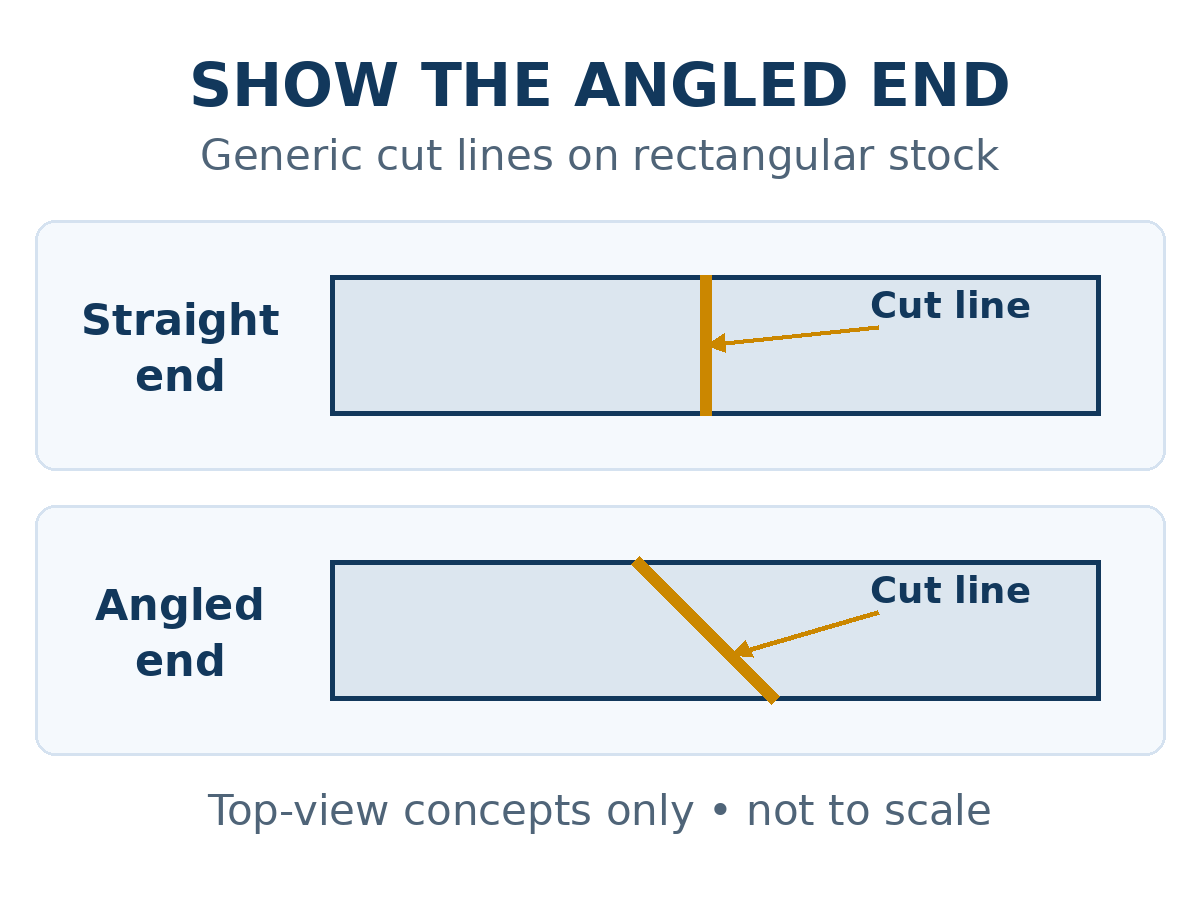
Make a short production matrix from parts you are actually permitted to manufacture. For each profile, record the cross-section and wall thickness, alloy, raw-stock length, finished length, end geometry, quantity per order, changeover frequency, protected surfaces and downstream assembly datum. Separate a square end from an angled end on the drawing. An angle requirement should identify the reference face and which end of the piece is measured; a bare “45°” in an email is not enough to configure a fixture or agree an inspection.
Rank the jobs by frequency and risk. A rare miter on an otherwise straight-cut schedule may be a fixture and setup question. Repeated angled ends across many drawings are a machine-workflow question. Neither statement decides the machine by itself: the profile’s usable orientation, clamp contact, cut envelope and acceptance tolerance still need a sample review. Use the machine-category overview as a starting map, then ask for a drawing-based configuration decision.
JR-455Q vs JR-550Q: what each direction asks of the operator
The semi-automatic range describes manual loading, controlled clamping and circular-saw cutting for varied smaller batches. That makes the JR-455Q a sensible candidate to investigate when operators change profiles and lengths frequently and the ordinary released parts are straight-cut. It does not mean every shape, end detail or angle is supported as delivered. The company catalog notes that a suitable fixture may enable 45° work on some semi-automatic setups; obtain a written drawing review for the exact profile and fixture before placing that job in the JR-455Q column.
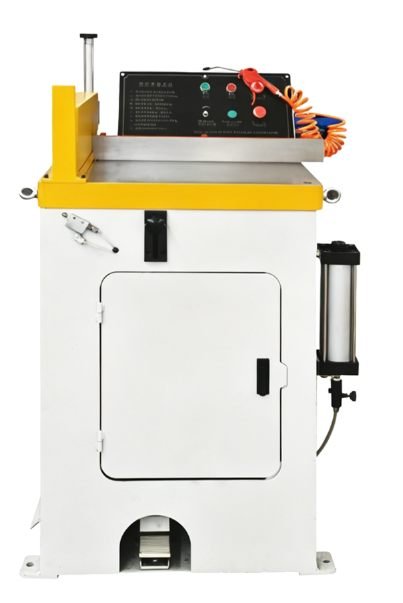
The catalog identifies JR-550Q as a single-head rotating angle-saw direction and lists a 35–145° angle range. Treat that as a catalog screening range, not a promise that every angle, profile orientation and section size can be used together. Ask how the actual saw head, guard, fence, clamp and stock support work at the tightest and widest angles on your part list. Also ask whether an operator must reset stops or reorient the part between ends. A single-head angle machine is not automatically an automatic feeder or a two-head line.
Use a decision matrix for the actual purchase
Use the matrix below to decide what to test, not to award a machine automatically. The same nominal profile may behave differently after you change its orientation, wall thickness, surface protection or part length.
| Released job pattern | First direction to investigate | Evidence to request before a quote |
|---|---|---|
| Mostly straight ends, short varied batches and frequent manual changeovers | JR-455Q semi-automatic workflow | Actual profile support, clamp contact, usable length range and operator loading sequence |
| Recurring angled ends with documented reference faces and several required angles | JR-550Q single-head angle workflow | Usable clearance at each angle, rotation and re-clamp sequence, angle inspection plan |
| Mostly straight work with one occasional 45° family | Compare a validated JR-455Q fixture proposal with JR-550Q setup | Fixture drawing, changeover time, guarded travel and first-article acceptance on the real profile |
| High output with repeated automatic feeding or paired end processing | Escalate to another machine category | Cycle plan, stock handling and feeding requirements; do not infer these from either model name |
Do not convert this table into a claimed cycle-time or accuracy comparison. Neither a catalog image nor a 45-second clip proves production rate, burr level, tolerance or available configuration for a customer drawing. The meaningful comparison is a quoted setup plus a repeatable trial on representative stock.
Trial both candidates on the parts that can change the answer
Choose at least one ordinary straight-cut job and one demanding angle job from your approved mix. Include the longest stock or most awkward profile orientation if it changes handling. Before cutting, agree how the stock will be supported, which side is the datum, where the operator stands, and whether the same blade, fixture and clamping condition will be used for the comparison. Record each setup change separately so the buyer can see whether a result came from the standard machine or an added fixture.
Inspect the first article and then a defined small run. Check finished length from the agreed faces, angle from the drawing datum, visible-surface marks, burr condition and fit in the intended assembly. Keep the measurement tool, calibration status, method and acceptance limits with the samples. If an angle cut changes how the piece seats in the clamp, inspect that position as its own job rather than extrapolating from the 90° sample. A feed-position specification is not a finished-part tolerance.
Ask the supplier to show the operator’s steps from raw bar to accepted part: load, orient, clamp, set angle or fixture, cut, release, identify and remove. Record manual interventions and changeover tasks. This is especially useful when one model looks compact in a catalog but your longest bar needs a long infeed route or your short part needs a safe outfeed method. The trial should identify dependencies, not manufacture an impressive best-case number.
Video: an equipment example, not a trial certificate
The following clip is published by Jiurun Machinery’s YouTube channel and shows a semi-automatic saw with roller supports and the guarded saw area. It is a general equipment example for one direction in this comparison. Treat it as general equipment footage: it does not verify the particular machine configuration, material, customer part, angle list, test cut or performance discussed in this article. Ask for current configuration drawings and a representative sample trial for your project.
What should be written into the RFQ?
Send a controlled package rather than a photograph and an output target. Include the profile cross-section with wall thickness and protected face, alloy and stock length, finished-part drawings with every end condition, annual or monthly quantity by family, batch size, tolerance and assembly-fit criteria, and the intended inspection method. Mark the angle jobs that are indispensable, not merely possible future work. If you already have a preferred jig or handling rack, provide its dimensions and interface requirements.
Request a reply that separates standard equipment, quoted options, customer-supplied fixtures and items still subject to sample approval. For JR-455Q, the response should state whether any angle fixture is proposed and what that fixture covers. For JR-550Q, it should show the usable part and angle envelope together, plus the manual sequence for two-ended parts. For either direction, ask what can be demonstrated before acceptance and what remains an engineering assumption. This avoids purchasing a headline angle range while leaving the difficult parts outside the confirmed scope.
Frequently asked questions
Can JR-455Q replace a dedicated angle saw?
Only a reviewed configuration and a representative cut can answer that for a specific drawing. A semi-automatic saw with an approved fixture may cover some angle work, but that does not establish the full JR-550Q angle range or the same changeover workflow.
Does the catalog angle range prove my profile fits?
No. The listed JR-550Q angle range is one screening attribute. Profile size, orientation, clamp clearance, support and guarding at each required angle need a machine-specific review and trial.
Which model is faster?
There is no defensible universal answer from the model names. Compare the complete cycle and changeovers for your real batch mix, including manual loading, angle-setting, part removal and inspection. Request a recorded trial rather than a guaranteed rate inferred from a short video.
Request a drawing-based comparison
If you are weighing JR-455Q vs JR-550Q, send JiurunCut your representative straight and angled part drawings, stock data, quantities and acceptance criteria through the contact form. Ask for the proposed configuration, what is included in the quotation and which parts should be sample-cut before an order. For published background, see the company catalog and the semi-automatic machine page. Final capability and outcome depend on the confirmed machine and part setup.