
“Servo feed” is incomplete as an aluminum saw specification. It may describe the mechanism that indexes a bar, the motion that advances the saw head into the material, or another programmed axis. A quotation that names the motor without naming its job cannot tell you which part of your production problem the option solves. Before comparing prices, ask the supplier to identify every moving axis, its drive, its usable travel, and the finished-part test that will confirm the proposed configuration.
This guide is for a buyer comparing quotations, not a claim that every JiurunCut model has the same drive arrangement. A machine can combine different motion technologies. For example, one sawing-machine maker describes a servo ball-screw material feeder alongside hydraulic saw-blade feed on the same product. JiurunCut’s JR-550CNC-CORNER product page separately describes automatic material feeding and servo positioning. Those descriptions show why an axis-by-axis answer matters; neither is a substitute for the configuration written on your own quote.
First, label the motions before discussing the motors
Draw the material path from the incoming bar to the accepted part. Then give each motion a plain name. The stock feed moves the extrusion to a cutting position. The saw-head or blade feed advances the cutting tool through the section and retracts it. Angle positioning changes the cutting geometry on machines that offer that movement. Clamping holds the chosen datum while the cut takes place. The spindle drive rotates the blade; it is another drive and should not be confused with either feed axis.
A supplier may use “feed” for more than one of these actions. Ask for an annotated layout or a short axis schedule with one row per motion. Record whether the motion is automatic or operator initiated, what controls it, and which quoted accessories or fixtures are needed. Do not infer the arrangement from a photograph of a control cabinet, a motor count, or the words “CNC” and “servo” alone.
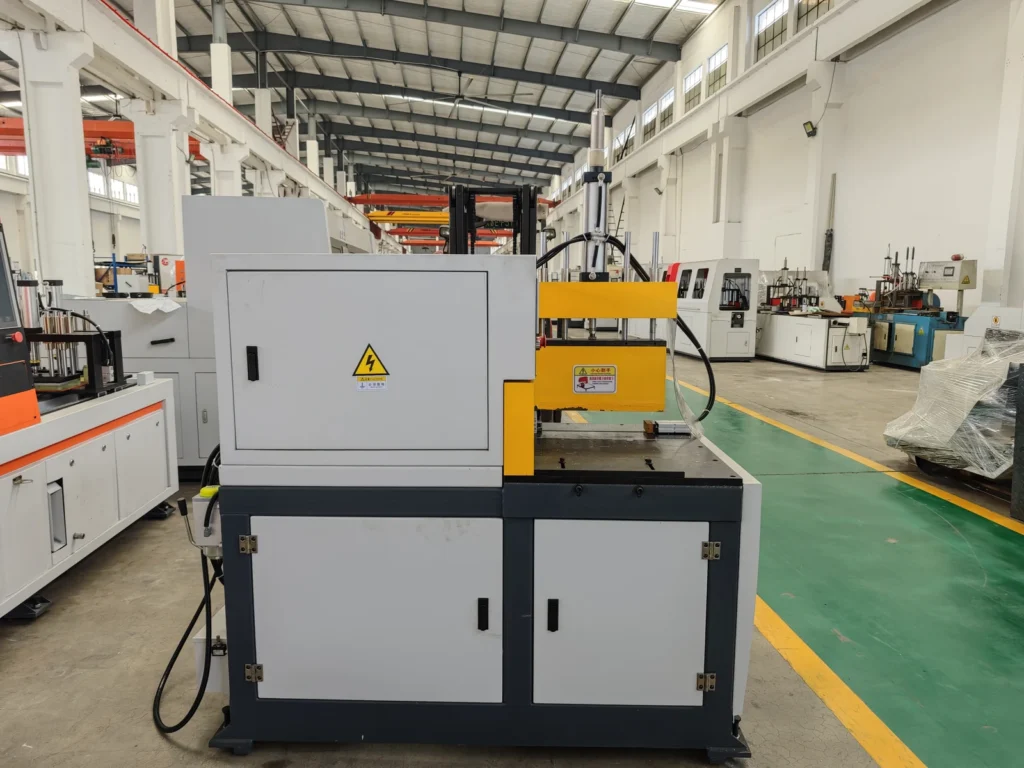
What the quotation must say about each axis
Request a configuration table rather than a single “servo feed” tick box. For the stock-positioning axis, ask how the bar is gripped and supported, the stated single-stroke travel, how multiple strokes are handled, and where the position is referenced. For the saw-head feed, ask what advances and retracts the blade, which cutting and return settings the operator can change, and whether those settings belong to the offered configuration. For an angle axis, ask which angle is programmed and which elements move. For clamping, identify the actuator and the actual contact faces; a servo stock feeder does not imply servo clamping.
For each line, include the drive type, model or component identification where available, control method, included versus optional status, operating limits, and who will support the component after delivery. If the supplier offers an upgraded feed package, have them mark the exact axis that changes and revise the drawing, parts list, price, lead time, commissioning scope, and acceptance procedure together. An upgrade on one axis should not silently be presented as an upgrade to the whole machine.

Test stock positioning as a finished-part task
If the buying problem is repeated finished length, a servo-driven stock feeder may be relevant. The test still needs to measure accepted parts, not only encoder counts or commanded travel. Give the supplier representative profile sections and stock lengths, a cut list with at least two required lengths, the datum from which each length is measured, quantity, tolerance, and any tail-material constraint. Agree which pieces are first pieces, steady-state pieces, and pieces after a length change.
Ask the operator to run a planned sequence such as length A, then B, then A again. Observe whether the bar remains supported and referenced over the usable travel, whether the clamp changes contact, how the machine handles a short remainder, and whether the finished length after the return to A is accepted. Record the measured part result and the setup used. A stated feeding-position accuracy is a property of a motion system; it is not automatically the tolerance of a cut part. Blade kerf, datum choice, clamping, stock movement, and the inspection method all affect the delivered result. Our separate guide on stock-travel measurement helps define what a feed claim actually measures.
Test saw-head feed as a cut-through task
If the problem is blade advance through a thin-wall, hollow, or changing section, the saw-head feed deserves a separate trial. Agree the blade, representative alloy and section, clamp arrangement, cut-face criteria, and safe operating procedure. Run the same agreed part family under the settings that will be handed over with the machine. Compare the cut face, burrs, visible-face marks, and accepted count. Include the return movement and any programmed change between section types if the quoted control allows it.
Do not assume one drive technology always makes a better cut. An equipment maker’s hydraulic-versus-servo explanation describes differences on its own machines, including programmable servo motion and hydraulic flow adjustment. That comparison is useful for framing questions, but its performance numbers and features cannot be transferred to a JiurunCut offer or another supplier’s machine. Ask the shortlisted suppliers to prove the result on the material, blade and cycle you will actually buy. Keep guards in place and use the manufacturer’s approved test procedure; a buyer does not need an unsafe view of the moving blade to validate a cut.
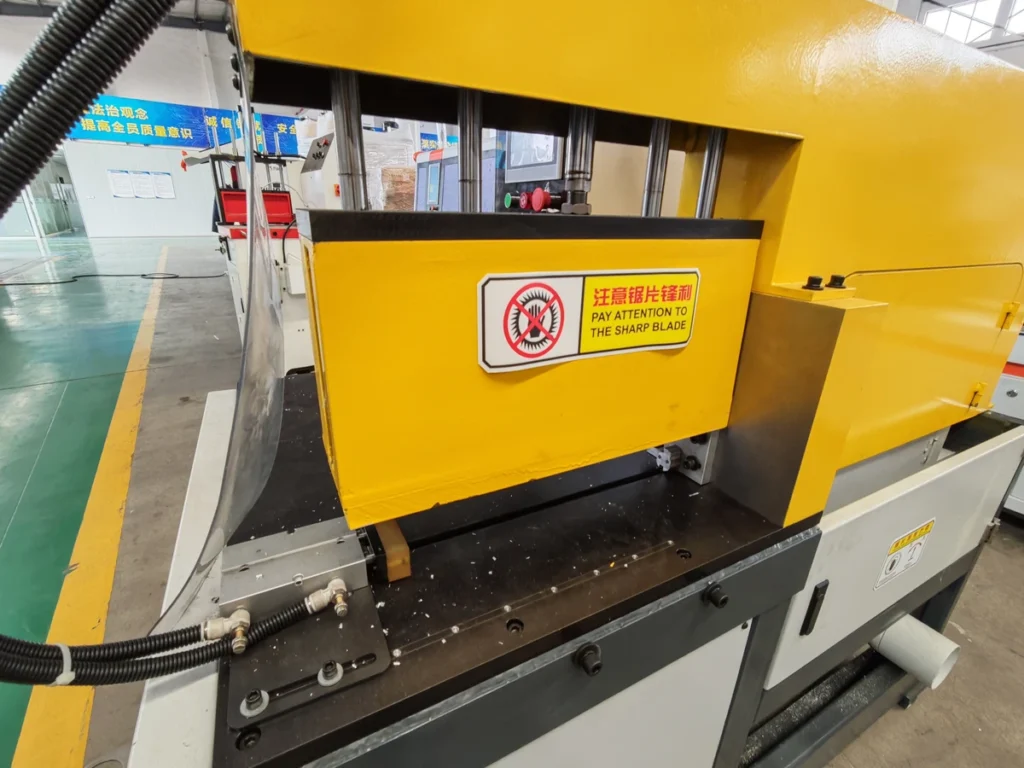
Use one acceptance sheet for the complete cycle
An axis demonstration is useful only when it connects to the buyer’s output. Write down the proposed machine version, software and fixture configuration, profile drawing revision, alloy and wall thickness, blade specification, stock length, cut list, operator actions, sampling plan, and inspection method. Measure finished length against the agreed datum and inspect the cut face under agreed criteria. Record the accepted count, rejects, reasons for rework, and tail pieces. If throughput matters, time a representative sequence that includes loading, a length change, cutting, removal and inspection rather than quoting only an isolated cutting stroke.
Ask for a separate result when the stock-positioning drive changes and when the blade-feed drive changes. If the supplier cannot separate the effects on paper, request a video or witnessed trial showing the relevant motion and the resulting parts. Still verify the physical configuration in the final order. Our length-positioning guide explains why the motion behind a entered length must be explicit.
How to compare a hydraulic and a servo proposal fairly
Start with the same production task and mark which axis differs. One quotation might use servo material indexing and hydraulic blade advance; another might change only the blade advance. A blanket “hydraulic versus servo saw” comparison would hide that distinction. Compare the included controls and adjustment range, expected service tasks, replacement-component identification, local support, and the accepted-part results. If the quoted option costs more, ask what measured improvement or reduced operator work is expected for your batch mix. If the evidence is absent, treat the benefit as unproven rather than assuming either technology wins.
The buyer should also ask who owns setup values and fault recovery. Can a trained operator select the agreed program? Which settings are restricted? What happens after a stop, stock slip, or material change? Which drawings, parameter list and service instructions arrive with the machine? Make the answers part of the handover. Our pneumatic-versus-hydraulic guide addresses a different question: actuation choices around the saw. Do not merge that choice with the feed-axis decision.
RFQ wording a buyer can send
“Please identify each powered motion in the offered aluminum saw: stock feed/length positioning, saw-head advance and retract, angle positioning if applicable, spindle drive, and clamping. For each motion, state the actuator and control, usable travel or setting range, included/optional status, relevant drawing or parts-list reference, and service support. Please propose a representative A–B–A cut trial on our profile, report finished-part measurements and accepted output, and show which quoted option changes which axis.”
Attach the profile section and wall thickness, stock length, finished lengths, angle list, tolerance, visible-face requirement and expected batch sizes. A supplier can then respond to the job rather than sell the word “servo.” If one item is still undecided, mark it as an open configuration question before price or lead-time acceptance.
Video: an equipment-flow example, not an axis certificate
The video below is from JiurunCut’s own channel and shows general JR-510CNC-3A-1S equipment and aluminum-profile handling/cutting views. It is an example of equipment flow only. It does not verify the drive assigned to any axis in your quoted machine, a specific material, fixture, customer trial, finished-part accuracy or output rate.
Watch the JiurunCut equipment video on YouTube.
Decision rule before placing the order
Accept a feed-drive description only when it names the axis, appears consistently in the quotation and configuration documents, and is tied to a representative finished-part acceptance test. If the result meets your drawing and production target, the drive arrangement is one part of a supported buying decision. If the quote still says only “servo feed,” send it back for an axis map and a trial plan. Send JiurunCut your profile and cut list to discuss the configuration and which motion needs to be demonstrated.