
The model name on a saw quote is a starting point, not an acceptance specification. Jiurun’s catalog uses JR-650CNC-3A-1S in more than one equipment presentation. One table describes a shorter single-feed arrangement; another presents a long-stroke zero-tail arrangement. A buyer who copies a number from one page into the other configuration can order the wrong feeding path or assume an unsupported profile size. Before you approve a JR-650CNC-3A-1S quote, make the supplier identify the exact proposed version and test it against your actual parts.
This guide is for a plant buying an automatic 90-degree aluminum profile cutting system for repeated production. It is a decision checklist, not a promise that every machine bearing this model name has the same feed stroke, section envelope, tail behavior, or finished-part tolerance. Request a dated drawing and configuration sheet for the machine actually offered.
Why the same model name needs a configuration check
The Jiurun catalog places JR-650CNC-3A-1S in a family table that lists a 1,200 mm single-feed stroke. A later presentation of a long-stroke, zero-tail family uses the same model designation and lists a 6,300 mm single-feed stroke. The neighboring model rows and maximum section envelopes also differ. These are catalog presentations, not permission to combine the largest value from each table. A quote should reference one identified configuration, revision, and drawing set.
The distinction matters operationally. A 1,200 mm stroke does not by itself limit finished length to 1,200 mm: a machine may advance a profile in multiple indexed moves, subject to its program, support, and remaining-stock rules. Conversely, a long feed stroke does not establish that every short part, large cross-section, or difficult profile can be cut within the quoted cycle. Ask for the full feed sequence for your cut list rather than inferring capability from one stroke number.
1. Identify the exact machine being offered
Put the model, configuration code, quotation revision, and date on the same line of the purchase specification. Request a general arrangement drawing showing the saw head, infeed, outfeed, guarding, controls, and any automatic loading equipment. Mark which items are included, optional, or supplied by the buyer. If a sales illustration shows two machines or a loading line, do not assume that arrangement is included in a quote for one saw.
Ask the supplier to identify the catalog page or technical-sheet revision behind each figure. The answer should reconcile the 1,200 mm and 6,300 mm single-feed presentations, including whether the offered machine is the short-stroke or long-stroke layout. If neither published layout exactly describes the offer, the signed quotation should carry its own controlled specification. Treat an unlabeled model photograph as a machine-family illustration until the supplier ties it to a particular serial or build configuration.
2. Test the usable profile envelope with real sections
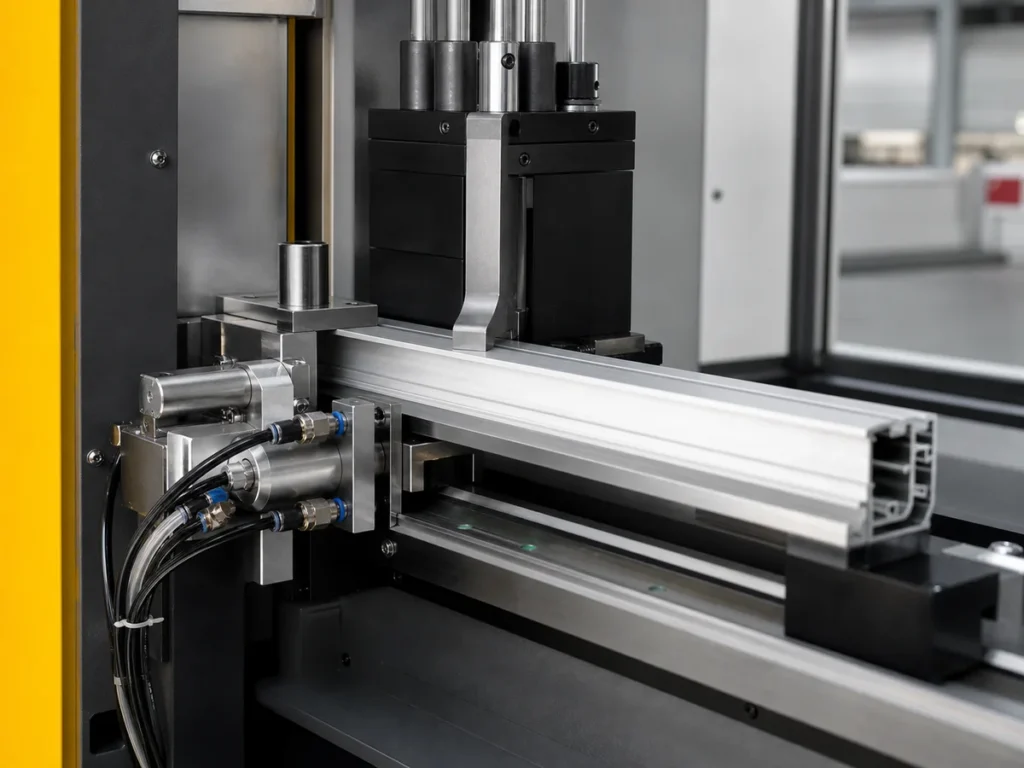
Send dimensioned cross-section drawings for every extrusion family. State the orientation in which each profile will enter the saw, its longest unsupported span, wall thickness, local ribs, visible faces, and any protective film. A catalog maximum height and width is only an initial screen: a profile can fit inside a rectangular envelope yet still be hard to clamp without deforming a thin wall or marking a finished surface.
For each profile, request a fixture sketch that identifies the datum faces, contact pads, hold-downs, side stops, and support rollers. Where sections vary, ask which adjustments are routine setup and which require new jaws or tooling. Record the maximum stock length and weight that the entire loading and support route can accept, not only the size that fits beneath the blade. Keep the approved section drawing with the quote so “the same profile” cannot later mean a different wall or extrusion revision.
3. Walk one long and one short order through the feed path

Choose two representative orders: a long finished member near the upper end of your requirement and a short repeated part that creates tail and handling questions. For each, provide stock length, target finished length, quantity, kerf allowance, end-trim rule, and acceptable remnant. Ask the supplier to return a step-by-step feed diagram: where the stock starts, each index or regrip, the cut position, the supported outfeed length, and the final remnant location.
This exercise exposes gaps that a nominal stroke figure hides. Check whether the stock must be pre-cut to enter the loader, whether it can be regripped after the first cut, and whether the outfeed needs a separate support or take-away device. If multiple profiles are loaded side by side, specify whether they are cut together or sequenced; do not infer throughput from the number of storage positions. A useful acceptance test includes the complete route from raw bar to identified finished pieces and scrap, including manual interventions.
4. Define what “zero tail” means for your order
“Zero tail” is a configuration description, not a guarantee that every bar becomes saleable parts. Blade kerf, end conditioning, fixture clearance, clamp reach, and the arithmetic of the order all affect the remaining material. In the quote, define the actual metric: minimum grippable remnant, physical uncut tail after the last cut, or material not allocated to acceptable parts. Those are different numbers.
Ask for a sample cut plan using your stock length and mixed lengths. Have the supplier label the final clamp position, the last accepted part, kerf losses, trim pieces, and leftover stock. Agree on whether a remnant may return to inventory and what identification it needs. Compare alternative cut plans on accepted finished parts per bar, not on a generic utilization percentage. If the offer includes a different clamp, transfer, or waste-discharge mechanism to reach the proposed tail result, list it explicitly in the scope.
5. Separate positioning claims from finished-part acceptance
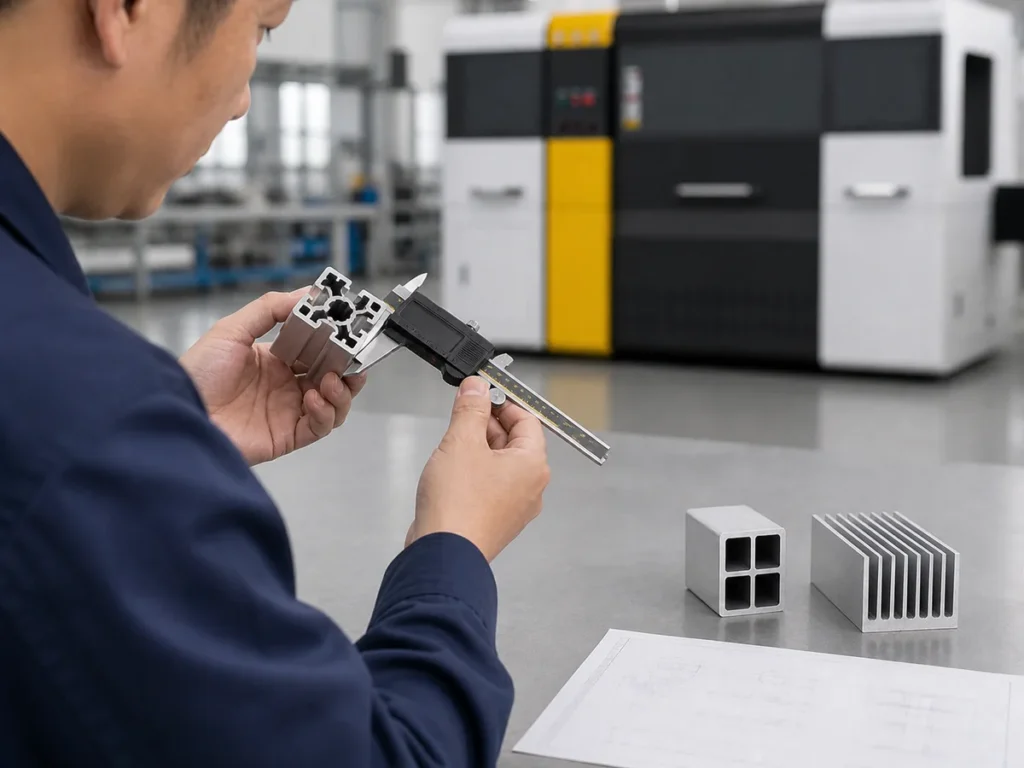
The catalog prints positioning-related figures, but a feed repeatability or axis-positioning number is not automatically the tolerance of a completed part. Finished length depends on the datum, stop or feed motion, clamp movement, blade condition, profile temperature and straightness, burr allowance, and how the part is measured. Ask the supplier to state exactly which quantity each printed tolerance measures and under what conditions.
Write a trial protocol around your drawing: sample profile and stock length, blade and fixture, target lengths, sequence size, measuring instrument, temperature or conditioning rule where relevant, and the faces used as measurement datums. Inspect the first pieces and pieces after a long run or regrip. Record length, squareness where specified, burr or surface condition, and whether the result remains acceptable across the lot. A successful machine demonstration is useful evidence for the tested configuration and material only; it is not a blanket promise for every extrusion you may later purchase.
For context, ISO 230-2:2014 describes direct measurement of positioning accuracy and repeatability of numerically controlled axes. A finished extrusion sample still needs its own agreed dimensional check.
6. Make the quote boundary visible
A comparable purchase price should identify the saw, feeding mechanism, roller tables or supports, guarding, dust or chip handling, mist or lubrication supply, electrical and compressed-air interfaces, installation, training, and spare tooling. Ask for footprint and utility drawings before factory layout approval. State who supplies the blade, profile-specific jaws, measuring gauges, and any host-system connection. Tie the promised commissioning milestone to a written factory or site acceptance checklist.
When evaluating two offers, compare the same complete production route. A lower equipment price may move loading, outfeed support, fixture engineering, or measurement labor to your team. A longer nominal feed stroke may add little value if your actual parts are short and changeovers dominate; a shorter stroke may still serve long parts if indexing and support are proven. The right decision is the version that processes your approved section set and cut list with a verifiable handover, not the version with the most attractive isolated number.
Related equipment video from JiurunMachinery: this footage shows a general automatic aluminum-saw example. It does not demonstrate the JR-650CNC-3A-1S configuration quoted here, the buyer’s profile or customer, a trial cut, or any performance claim.
Request package for a decision-ready quotation
Send the supplier one controlled package: section drawings and finish requirements; stock and finished lengths; order quantities and mixes; cut-end acceptance criteria; site layout and utilities; and two representative feed-and-tail scenarios. Ask back for the identified JR-650CNC-3A-1S configuration, revision, arrangement and fixture drawings, included equipment list, cycle and remnant assumptions, and an agreed sample-trial method. Keep the approved quote, drawings, and trial record together so purchasing, production, and quality inspect the same machine.
The Jiurun product range and industrial aluminum profile cutting overview show the broader equipment direction. They do not replace the configuration sheet for your order. Contact JiurunCut with your section drawings and cut list to request a version-specific proposal and a trial plan. No published image or video on this page establishes the performance of your proposed configuration; only the agreed quote and trial can do that.