
Appliance structural frame extrusions can create a legitimate sawing requirement, but the appliance label alone cannot specify a saw. A purchasing team first needs to establish which released frame members arrive as long aluminum profiles, which arrive cut or finished, and which apparent “frame” parts are actually formed sheet, castings, or purchased assemblies. This guide gives a seven-check RFQ method for a plant that retains some aluminum profile cutting. It does not assume every appliance or every frame has the same construction.
Extrusions are constant-cross-section shapes made through a die; Hydro describes solid, semi-hollow and hollow profiles in products that include home appliances. The Aluminum Association explains that fabrication commonly begins by cutting extruded length before further operations. Neither source establishes that a particular appliance maker cuts its own frame members. That is a job for the buyer’s released drawings, routing and make-or-buy record.
1. Appliance structural frame extrusions: prove the cut-stock boundary
Start with one actual frame family, revision and build quantity. Mark each aluminum member as long stock to be cut in-house, a cut-to-length supplier part, a machined or finished part, or a completed frame module. Record its approved input form and the operation that will receive the saw output. If an assembly uses mostly sheet panels and purchased rails, quoting a saw against the whole appliance volume will overstate the real workload. Conversely, a retained family of repeated extrusion members may justify a dedicated cut cell even when the finished appliance has many other purchased components.
A useful decision sheet has a row for each released member: drawing revision, alloy and temper if specified, profile cross section, supplied length, cut length and tolerance, end condition, batch demand, and next operation. Leave unknowns visible. Do not substitute an appliance envelope dimension for cut length or infer stock shape from a finished-product photograph.
2. Separate profiles from parts that need another process
Long straight rails, hollow sections and channels can be candidates for a profile saw. A bent panel, casting, already-machined bracket or assembled module is a different input. The illustration below shows distinct sections beside an assembled frame; it helps explain a bill-of-material boundary, not the construction of a named appliance or a customer project.
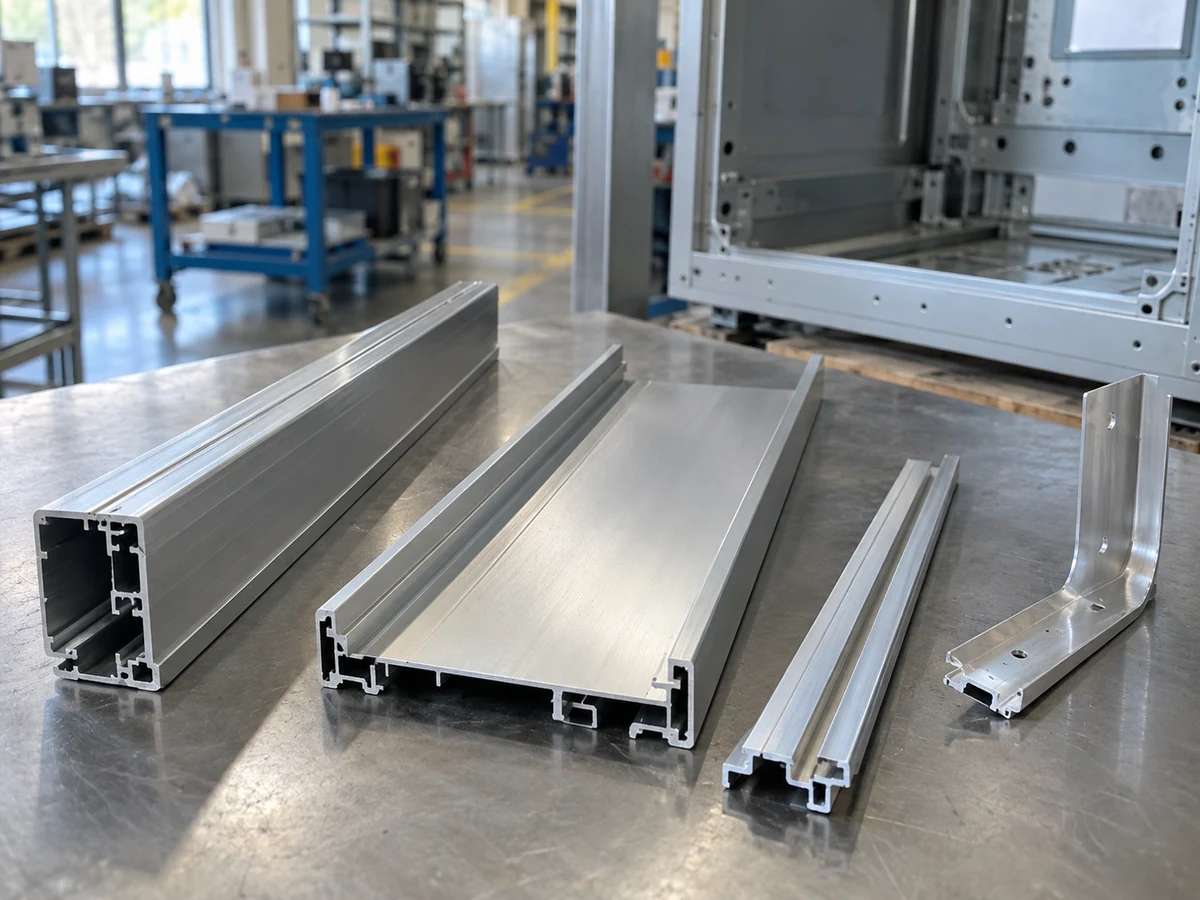
For each retained part, identify whether sawing produces the final end or merely a blank for drilling, milling, deburring, coating or assembly. This distinction changes how a sample is judged. A blank accepted for subsequent machining may have a different end-face requirement from a visible rail that goes directly into an exposed joint. Ask the downstream owner to approve the handoff condition, rather than promising a finished appliance-level outcome from the saw alone.
3. Build the RFQ around the hardest released profile
A catalogue capacity number is not enough. Select representative released profiles that cover the largest envelope, thinnest wall, most vulnerable finish and shortest accepted cut. Provide the actual cross-section drawing and the permitted gripping zones. Hollow features and open channels may need different support against collapse or twist; a protective finish may change contact and handling requirements. A supplier should explain the proposed blade path, hold-down locations, support and unloading for each sample, then demonstrate on the buyer’s stock.
The existing media-library image below shows long sections and shorter pieces near a frame. It illustrates why input stock length, minimum usable remnant and safe support belong in the same question. It is not a documented setup for the model being purchased.

For more detail on how a profile can deform under a poorly chosen grip, see our thin-wall aluminum profile clamping checks. That general guidance does not replace a trial on this frame family.
4. Define what “good cut” means at the receiving station
Specify a measurable acceptance plan, not just “clean and accurate.” State which length datum is used, whether the end must be square or angled, where burrs are permitted, which cosmetic faces must be protected and how the receiving operator will inspect the part. If later machining establishes the final interface, say so. If a cut edge remains visible, have quality and assembly agree on an actual approved sample.
Keep feed-position repeatability separate from finished-part accuracy. Saw positioning, clamping, blade condition, extrusion straightness, burr removal and the measurement method can all affect the accepted part. Request a documented trial with first, middle and late pieces from a representative batch, not a single selected coupon. Record rejected pieces and the cause as well as accepted ones.
5. Quote changeovers against the released mix
A nominal high-throughput saw may be poor value for frequent low-volume frame variants. Supply the actual list of profile families, lengths, angle settings, changeover frequency and batch sizes. Ask how the proposed machine stores or recalls a cut list, how the operator confirms the correct stock and revision, and which tooling changes require manual intervention. Quote cycle time only for a defined sample and method. Include loading, sorting, inspection and changeover time when comparing alternatives.
Where several appliance programs share a line, give each one a clear traveler or batch identifier. A short rail for one frame can resemble a longer rail for another after cutting. The value of traceability is avoiding a correct-looking part at the wrong receiving station; it should be designed into the workflow before automation options are priced.
6. Compare three supply routes on the same boundary
Buy finished frame modules when the supplier owns cut quality, finishing and joint fit and the plant gains little from an extra cut step. Buy cut or prepared members when the plant wants assembly control but can outsource profile conversion. Cut approved extrusions in-house when a stable retained workload, revision control and receiving process justify equipment and operator resources. A mixed route can assign high-volume stable rails to the saw while leaving difficult low-volume members with a qualified supplier.
Compare total delivered cost for the same accepted frame-member package. Include stock yield and remnant policy, changeovers, inspection, downstream machining, external finishing, packaging, rejected pieces, labor, floor space and support. Do not compare the purchase price of raw bar with a finished module without accounting for the work between them. The right route may differ by member family, and the RFQ should preserve that distinction.
7. Require a witnessed trial and a narrow acceptance statement
Before placing an order, send the supplier released drawings, representative actual stock and a written acceptance sheet. Witness the proposed support and clamping method, cut the shortest and longest relevant parts, review the end face and length using agreed measurement equipment, and hand a sample to the next process or assembly fixture. Record the exact machine configuration, blade, material lot, cut list, operator actions and results. If a feature still needs machining or a surface finish, document it as outside the saw trial.
The trial should end with a decision: which retained member families passed, which need different fixtures or conditions, and which should remain purchased as prepared parts. A video of a generic saw cannot verify this application. Any maker-specific cut-length guarantee, appliance fit, electrical performance, vibration, durability or certification claim requires its own evidence and is outside this purchasing guide.
RFQ handoff checklist
- Released frame member drawings and revision-controlled cut list.
- Approved material, stock form, supplied lengths and sample quantities.
- Final versus blank end-face requirements and protected surfaces.
- Representative worst-case profiles, minimum cut length and batch mix.
- Actual receiving station, inspection method and acceptance samples.
- Scope of tooling, training, maintenance, chip handling and changeover.
- Witnessed trial protocol with pass/fail record and open exceptions.
If you have approved profile drawings and a clear retained-cut boundary, send Jiurun the frame-member package for a saw RFQ. We can discuss a suitable trial plan around those inputs; no machine configuration or result is assumed from the illustration or general equipment video.
Video example: The JR-550CNC footage below shows general aluminum-profile angle-saw equipment and a sample operating sequence. It does not show this appliance frame, a specified material or configuration, a customer trial, or verified cut quality or production performance.