
A custom aluminum saw system is a procurement decision before it is a machine description. A buyer may need only a standard saw with a documented option, a configured package of known equipment, or a separately engineered project. Those routes differ in what must be proven, who owns each interface, and when a price and delivery promise can be trusted. The word “custom” alone does not settle any of that.
Start with the cutting job you must release into production: actual stock sections and lengths, required cut geometry, order mix, incoming presentation, outgoing part condition, and the downstream handoff. Then compare supplier responses against the same job. A photograph of a machine family illustrates a possible starting point; it does not establish that a particular material, fixture, feeder, discharge arrangement, or performance claim is included in your quote.
Custom aluminum saw system: three purchase routes
Standard machine: the published base model and its documented supplied equipment already cover the approved cutting envelope and operating method. Your order still needs an exact model, voltage, accessories, installation scope, and acceptance plan. “Standard” does not mean every pictured component is included.
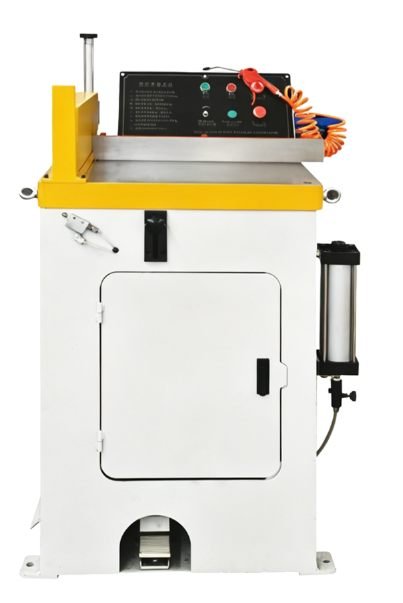
Configured machine: the buyer selects defined options or a known combination of saw, feeding, clamping, controls, and receiving equipment. The supplier should identify each selected component, its compatibility limits, exclusions, and the resulting delivery configuration in one revision-controlled offer. A choice from a catalogue can still require a real application review.
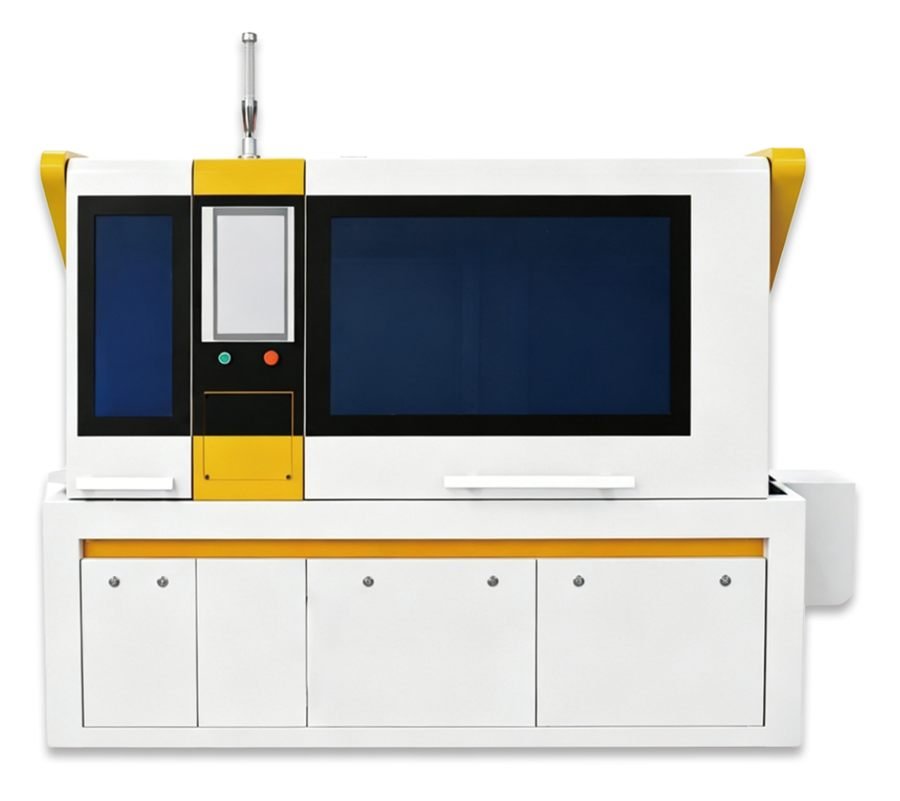
Engineering project: a requirement remains outside the documented base or option scope. It might involve a new workholding method, unusual stock presentation, a connected process, or a controlled part-transfer sequence. Treat this as an engineering assessment with stated deliverables and decision gates. Do not convert an attractive concept into an assured capability, fixed lead time, or acceptance result until the supplier has reviewed and committed to the exact task.
Define the same production job before comparing prices
Make a small representative job set, not a single ideal sample. List each stock family with section drawing, alloy and temper where known, incoming length and straightness assumptions, surface condition, and whether members arrive singly, in bundles, or as short remnants. List cut angle, length references, lot size, changeover frequency, and which face must be protected. If a drawing is confidential, agree on a controlled way to share the critical geometry without replacing dimensions with a vague label such as “aluminum profile.”
Describe the output in equally concrete terms: a loose blank, identified kit, protected visible face, sorted remnant, or part presented for the next operation. A saw’s nominal cutting range is only one boundary. The buyer should also ask where the first and last usable part are supported, how shorter pieces are held or discharged, and which dimension is measured after cutting. Feeding-position accuracy is not automatically finished-part accuracy.
Separately mark work that the saw purchase will not perform, such as drilling, milling, deburring, washing, labeling, packing, or final assembly unless the quotation explicitly includes it. This avoids paying for an assumed production line while receiving a sound cutting station. For complex cells assembled from different vendors, the multi-supplier saw-cell scope guide addresses the distinct question of interface ownership.
Use a gap register to decide whether engineering is necessary
For every requirement, request one of four answers: covered by the quoted base machine, covered by a named option, subject to engineering assessment, or excluded. Add the evidence that supports the answer: catalogue drawing, application drawing, layout, interface specification, or a documented trial plan. An unanswered row is a decision risk, not a hidden option.
| Requirement | What to ask the supplier to show | Decision implication |
|---|---|---|
| Stock and cut envelope | Sections, orientation, angles, lengths and support points covered by the proposed setup | A catalogue maximum alone may be insufficient |
| Feeding and clamping | Actual stock presentation, grip locations, changeovers and remnant handling | May be an option or a new fixture task |
| Control and data | Recipe input, operator actions, traceability and machine-to-line signals | Interface responsibility must be named |
| Discharge and handoff | Part orientation, bins, receiving height and who confirms the transfer | The cell boundary may extend beyond the saw |
| Site and acceptance | Utilities, floor space, guarding, installation tasks and measurable trial criteria | Unresolved scope changes cost and schedule |
For example, if a buyer needs two angle-cut profile families and a change in clamp position, first ask whether a documented angle-saw configuration and compatible workholding already cover both families. If the request also includes automatic bundle separation, part identification and a downstream transfer signal, those added boundaries may need a project study. The answer depends on reviewed drawings and supplier commitments, not on the word “automatic.”

What an engineering assessment should produce
If a gap cannot be closed with an existing configuration, ask for a bounded study before treating the system as ordered. The assessment should identify the input samples and drawings received, unresolved assumptions, proposed machine and handling boundary, preliminary layout, critical interfaces, safety responsibilities, a test method, and items requiring buyer approval. It should say which points are confirmed, conditional, or still open.
Agree who pays for and owns samples, fixtures, drawings and any trial work, and whether an assessment fee is credited to an eventual machine order. Ask what change in the input job would reopen the design. If the supplier cannot yet state a delivery commitment, record the next decision date and required evidence instead of writing a guessed lead time into a purchase request.
Engineering should also have a stop rule. A concept may prove uneconomic, infeasible on the available floor, or dependent on an upstream process the buyer does not control. The buyer should be able to choose a simpler configured machine, revise the job, or stop the project after the assessment. A custom aluminum saw system is justified by an identified production need, not by its novelty. As a general industry example, Behringer Eisele describes standardized handling choices and special solutions; that source does not establish any Jiurun model or project capability.
Keep quote scope, changes and acceptance connected
Request one versioned scope sheet for the selected route. It should list the supplied machine, chosen options, fixtures, software functions, guarding, infeed and outfeed equipment, installation and training tasks, spare parts, exclusions, site prerequisites, and each party responsible for an interface. Drawings and commercial terms should reference the same revision. The RFQ clarification guide helps keep different suppliers’ answers comparable before ranking offers.
For an engineered system, set approval points for layout, detailed design, agreed trial material, factory test and site acceptance. When a requirement changes, record the old and new scope, price effect, schedule effect, and changed acceptance criterion before authorizing the work. A successful cut from an unrepresentative stock piece cannot verify every family, changeover, discharge path or operator action in the promised job.
Define acceptance around observable outcomes: which stock and drawings are used, number of parts and changeovers, how dimensions and surface condition are checked, the agreed treatment of scrap and remnants, and how faults are recorded and resolved. Include both machine-only checks and connected-process checks when the quote includes a cell. Do not infer finished-part tolerance from feed-positioning data or from a product photograph.
Related equipment footage, with a clear evidence limit
The following Jiurun channel video shows general angle-saw equipment and a cutting-area view. It is a process illustration only. It is not evidence that the material, model configuration, customer job, trial results, accuracy, or performance discussed in this article have been supplied or verified for your project. Any claims visible within the video require separate confirmation against the quoted configuration and an agreed test.
General Jiurun angle-saw equipment footage; not a demonstration of the proposed custom system, its configuration, material, customer or performance.
A practical purchase decision
Choose the standard route when the documented base machine covers the approved job. Choose a configured route when identified, compatible options close every relevant gap and the full delivered configuration is quoted. Choose an engineering assessment when a material requirement still needs a new design or interface decision. Hold the purchase commitment until the assessment resolves the critical scope, acceptance and commercial questions.
Send Jiurun your representative stock drawings, cut list, incoming and outgoing handling requirements, site constraints and intended acceptance checks. Ask for a written response showing what an existing machine or option covers, what needs engineering review, and what remains outside the offer. That response gives your team a defensible choice between a configured saw and a genuinely engineered project.