
An aluminum saw for marine fabrication should be purchased for a defined profile-cutting job inside your production route. A yard making outfitting assemblies, a subcontractor supplying prepared members and a repair shop producing occasional replacements can all handle aluminum, yet need very different equipment. Start with the work you actually retain, the incoming form of the material and the point at which another department accepts the output.
The useful buying question is not whether the machine is described as suitable for boats. It is whether the offered configuration can perform your released member work, through the changes that occur between projects, without relying on unstated preparation or transfer steps. Structural suitability, welding procedures and vessel acceptance remain separate responsibilities; a saw quotation cannot settle them.
This guide helps a marine fabricator build that purchasing scope. It covers the boundary between profiles and panels, newbuild and replacement demand, material identity, assembly-facing dimensions, representative trials and comparable quotations. The examples are invented planning illustrations, not Jiurun production results or marine approvals.
1. Define the marine fabrication work before selecting a saw
List the products that will actually pass through the proposed station. Possible families include profile members for outfitting frames, equipment supports and other drawing-defined assemblies. Name the real project items in your factory rather than building a list of every application that contains aluminum. A family belongs in the purchase scope only when your business is responsible for its cutting operation.
Then separate what arrives as long stock from what arrives already prepared. A purchased machined component may enter an assembly bay without any saw work. A supplier-made panel can have a completely different processing route from a loose extrusion. If both appear in the same marine project, that does not make them one machine requirement.
Hydro’s marine applications overview distinguishes structural and machined profiles, outfitting components and friction stir welded panels among its offerings. That is useful evidence of different supply forms and processes within marine work. It does not establish Jiurun’s capability for a particular section, authorize vessel use or make a profile saw a panel manufacturing line.
For each retained item, write a short route: received material, member cutting, any later preparation, assembly, inspection and delivery. Identify the responsible supplier or department at every boundary. This exposes whether the proposed saw is serving recurring member manufacture, a limited preparation operation or a small part of a much wider investment.
| Incoming job | What to establish for the saw inquiry | Separate scope to keep visible |
|---|---|---|
| Long aluminum profiles | Actual sections, cut ends, stock condition and receiving handoff | Later holes, connection features and assembly |
| Supplier-prepared components | Whether any cutting remains in-house at all | Supplier preparation and component acceptance |
| Sheet or plate parts | A separate assessment of the actual form and operation | Sheet processing, forming and other manufacturing stages |
| Purchased welded panels | Only the defined retained operation, if there is one | Panel manufacture, joining processes and project approval |
| Replacement members | Released drawing, identity and repeatable production requirement | Condition survey, redesign and installation decisions |
2. Compare newbuild, subcontract supply and repair demand
Newbuild work may release several families for one project, with shared completion dates but different drawings and material allocations. The machine must be assessed against the sequence your production planning actually uses. A long run of one member followed by a different section is not the same workload as many short project packages mixed throughout the day.
A subcontractor selling prepared members has a different delivery boundary. Its customer may expect identifiable pieces ready for a subsequent operation, rather than a finished assembly. The relevant evidence concerns those pieces and their stated receiving criteria. Do not add the customer’s full vessel assembly time to the subcontractor’s saw requirement, or omit preparation that the subcontract actually includes.
Repair and replacement work introduces another question: is the demand sufficiently defined to justify dedicated equipment? An existing installation may require a responsible survey or a released replacement drawing before manufacture. A damaged sample or a photograph can help describe the inquiry, but should not silently become a production specification. Identify which dimensions and material details remain unresolved.
Compare retaining cutting with purchasing prepared members on the same basis. Consider the actual recurring work, interruptions, inspection responsibility, material handling and availability of the required information. A factory may choose to retain repeatable profile work while buying more specialized components. That can be a valid boundary rather than a failure to own every process.
Ask what happens between projects as well as during the busiest contract. An attractive demonstration on one long run does not describe idle periods, new drawing releases or frequent material changes. Use observed workload records to explain the proposed station’s role; keep forecasts clearly labeled as forecasts.
3. Specify the real sections and the material identity
The outer envelope alone is an incomplete description of a profile. Send a section drawing showing walls, cavities, ribs, open faces and any features relevant to the proposed handling and cutting assessment. Show the end requirement separately. Two pieces with similar outside dimensions can present different jobs, while a large illustration may convey none of the dimensions needed for a quotation.
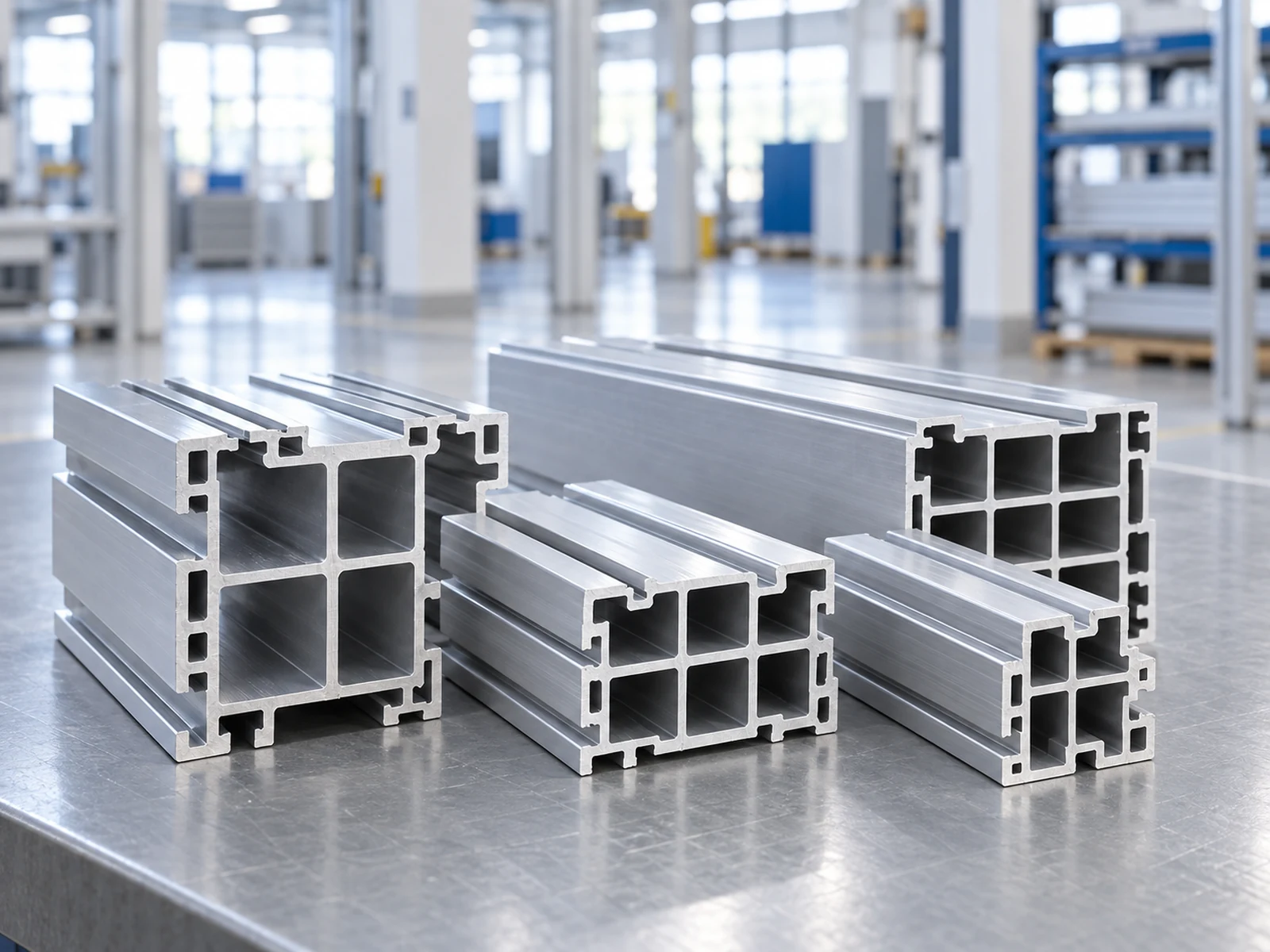
Identify the incoming material designation and condition from the documents that govern the job. Do not replace a specified designation with the general phrase marine aluminum. The equipment inquiry needs to explain what will be cut; the project’s material and product acceptance process determines what is permitted for the application.
Keep the identity of a stock length connected to the pieces made from it where your production requirements call for that relationship. Ask how the proposed workflow maintains the needed identification after cutting and transfer. This is a practical production question, not a claim that a particular traceability system or certification is included in the machine.
Also describe how stock arrives: available lengths, packaging, surface condition, straightness information and any supplier preparation. Record the usable material policy your own process applies. A material description that assumes clean, regular stock should not be used to quote a workload that actually includes mixed or uncertain incoming pieces.
For returned or recovered material, obtain a separate responsible assessment before treating it as equivalent to new stock. Unknown identity, damage or a missing drawing cannot be resolved by choosing a larger saw. Keep uncertain material outside a production-capability claim until the open requirements have been settled.
4. Translate assembly dimensions into a released member job
A drawing of the overall assembly does not necessarily specify every cutting operation. Confirm which dimensions apply to the individual member before and after later preparation. Name the reference used for its length and the intended end form. If the next process changes an end, the saw-stage requirement must describe the correct intermediate condition.
Angled members need particular clarity about the dimension reference. An outside envelope, a distance between interfaces and a long-point dimension are different descriptions. Provide the actual released requirement rather than asking the equipment supplier to infer it from an assembly picture. Where several drawings are involved, identify the current revision and which one controls each feature.
Separate cutting from connection preparation. Holes, slots, machined seats and joining details can affect how the member fits, but they are not automatically included in a saw-only offer. Specify which department supplies them and how the cut piece is located or checked at that handoff. Review the cutting and drilling route discussion where that is your actual production sequence.
Use assembly-facing evidence without turning the saw supplier into the vessel designer. A responsible assembly check may reveal that individually accepted pieces do not meet the complete fit-up requirement. Investigate the dimensional chain, preparation stages and drawing interpretation together. Do not assign every mismatch to the cutting machine or declare overall acceptance from one measured length.
Decide how an unresolved revision is handled before buying. A supplier can assess a stated cutting job, but cannot demonstrate repeatability against a requirement that changes during the trial. Freeze the evaluated member package, document later changes and reassess affected conditions instead of carrying an old result forward without explanation.
5. Plan the station around complete project packages
Marine production often cares about releasing a usable package to the next bay. Total cut-piece count can hide missing members or wrong allocations. Record which pieces belong together, which variants are interchangeable and which must remain tied to a particular project or assembly position.
For an invented example, suppose a released outfitting package needs two A members, two B members and one C member. Producing 30 packages therefore requires 60 A, 60 B and 30 C pieces. If receiving inspection accepts 64 A, 56 B and 31 C, the available quantities support only 28 complete packages. The spare A and C pieces do not compensate for missing B pieces.
That calculation assumes every accepted piece within each stated family is interchangeable for the package. If port and starboard variants, different revisions or material allocations are separate, count those families separately. The example illustrates production accounting only; it specifies no real vessel geometry, output rate or machine performance.
Map how pieces move from the station to the next operation. Identify the container or rack arrangement, labeling responsibility and required check before release. A pile of correctly cut members that must later be sorted and identified has a different labor burden from a controlled project package. Include that work when comparing routes.
Describe long-stock access, loading, support, collection and later transfer for the actual proposed layout. Have the equipment supplier explain the configuration and required site provisions. Do not infer safe handling or an approved holding arrangement from an illustration, or assume that every support item is included in the quoted price.
6. Evaluate capacity across the work sequence
Provide a representative schedule containing repeated members, short runs, changed sections and the checks that your process requires. Ask the supplier to identify which parts of that schedule the proposed configuration addresses and which need separate work. Comparing only uninterrupted cutting can conceal the production constraint you are trying to remove.
A meaningful observation starts at a stated point and finishes at another stated point. For example, you may want to observe received stock becoming checked members available to the next department. Make loading, identifying, changing the job, checking and transfer visible if they fall within that interval. Do not mix a blade-cycle figure with a complete-package output figure.
Use existing production records to distinguish recurring delays from occasional exceptions. If a saw is waiting on released drawings or an external preparation operation, faster cutting alone may not change delivery. If cutting is the recurring constraint, show the actual workload and downstream availability so that the proposed purchase can be evaluated against it.
Discuss future work separately from the current acceptance package. A later family may require another assessment of sections, material, ends or handling. A supplier’s willingness to discuss expansion is not evidence that every future marine component fits the offered machine. List the evaluated families and unresolved future cases in the quotation.
7. Require a representative trial and comparable quotation
Select trial members because they represent important production conditions, not because they are easiest to demonstrate. Include the different section families and end requirements that materially affect the job. Provide the material identity, drawings, current revision and receiving criteria before the evaluation begins.
Agree who checks the output and what information will be recorded. Keep cutting evidence distinct from later machining, joining and assembly observations. If a later stage is included in the trial, identify its equipment and responsible process. A successful isolated cut should not be described as proof of a complete marine manufacturing route.
Ask the supplier to state the evaluated configuration and material conditions. A video without those details offers context but leaves the purchasing question open. Conversely, a bounded evaluation can be useful even when it does not cover every future job, provided the offered scope matches your decision and the exclusions are explicit.
Compare offers using the same input package and output boundary. List included machine functions, handling provisions, installation responsibilities, operator training and stated service arrangements. Identify separate drilling, end preparation, joining and inspection equipment rather than assuming them from phrases such as complete solution.
Record the commercial boundary as well: what is delivered, what the site must provide and which open questions must be settled before final acceptance. A cheaper quotation that excludes a necessary transfer or preparation stage is not yet comparable to an offer that includes it. Request a clarified scope before treating the price difference as a saving.
8. Prepare your aluminum saw for marine fabrication inquiry
Send Jiurun a factory summary that explains whether you supply loose prepared members, assemble outfitting products or retain a limited cutting stage within a larger project route. Identify bought panels and machined components separately. Describe the actual reason for the purchase using observed workload or delivery constraints.
Attach representative section and member drawings, material designations, stock photographs, end requirements and the typical project mix. State the receiving point and the checks applied there. Include the key changeovers and the distinction between recurring newbuild work and separately assessed replacement work.
Ask for a configuration assessment with assumptions, exclusions and the evidence needed to close unresolved questions. Compare the proposed Jiurun aluminum cutting equipment with that defined job. The purpose is to establish equipment suitability for retained cutting work, not to approve a vessel design, welding procedure or marine product.
Frequently asked purchasing questions
Does a marine application label prove machine suitability?
No. Suitability needs the actual section, material condition, operation, handling arrangement and acceptance requirement. An industry label or a generic cutting demonstration cannot replace that assessment.
Can a profile saw replace plate processing or panel manufacture?
Those are separate scopes requiring their own assessment. Identify the form received and the actual operation retained. Do not transfer a result for one profile family to sheet, plate or a welded panel solely because all contain aluminum.
Should a repair sample determine the production specification?
It can provide information, but unresolved identity, condition and dimensions need responsible clarification. Use the released replacement requirement for the equipment assessment; a damaged piece should not silently become the design authority.
What output should the purchasing comparison count?
Count accepted members at the agreed handoff and, where relevant, the complete packages those members support. Keep variants and allocations separate. State whether later preparation or assembly is included so that different offers are compared on the same basis.
Send Jiurun your marine profile drawings and retained production scope to discuss the cutting configuration and the evidence needed for a bounded assessment.
Watch the cutting stage in context
This Jiurun video shows general aluminum cutting context. It is not a marine-component trial, vessel approval or proof of the invented package-count example. The actual material, member requirements and offered configuration need separate evaluation.