
A brass bar cutting machine should be selected for the blanks your production route actually needs. “Cut brass” is too broad to compare offers: the inquiry must identify the incoming stock, what leaves the cutting stage, how it reaches the next operation and which requirements need evidence. A fast-looking demonstration can answer a narrow cutting question while leaving the intended blank-production job unresolved.
Start with the approved material and part records. Separate blank requirements from the final machined component, then ask suppliers to confirm the proposed equipment against that defined task. Do not assume that a machine marketed for aluminum, or broadly described as suitable for nonferrous metals, is confirmed for your particular brass grade and workpiece.
Define the brass bar cutting machine input
The Wieland rods and sectional rods range distinguishes materials and geometries across its products. Its information is generic product guidance rather than a cutting result for your lot. Use such catalogs to identify the material information you must obtain, then send the actual stock specification to the equipment supplier.
Record the agreed grade or designation, delivery condition, section shape and dimensions. Include the stock length and the applicable dimensional requirements. If the bar is round, send the diameter information; if it is polygonal or another section, provide the actual drawing. A family label or an outside bounding size should not stand in for the complete workpiece.
State how the stock arrives at the cutting stage. Identify the lengths, packaging and lot records relevant to the proposed work arrangement. If material condition varies between approved sources, make that variation visible in the inquiry. Ask which incoming conditions the supplier has considered and which still require clarification or representative material.
Keep material selection separate from machine selection. A designation approved for the finished component does not prove the proposed saw’s performance, and a successful saw demonstration does not approve a different alloy for the component. The material supplier, part owner and equipment supplier answer different questions.
If lead-free stock is involved, identify the actual approved grade instead of using the label alone. The existing lead-free brass sawing discussion covers that narrower material issue. The complete purchase here also needs blank definition, handling, evidence and the next-process handover.
Specify the blank that must leave the saw, not just the finished part
A finished part drawing can include faces, holes, threads and other features created after cutoff. Establish which features must already exist when the blank reaches the next operation. The cutting supplier needs the blank drawing or a clearly approved cutting-stage requirement, rather than an invitation to guess the remaining manufacturing route.
Define the blank’s length, end requirements, dimensional limits and measurement references. If the later process removes material from an end, obtain the applicable blank requirement from the party responsible for that process. Do not impose a universal machining allowance based on a supplier’s unrelated example or the finished component length alone.
The incoming contour matters too. An existing polygonal section may provide part of the intended geometry, while another feature still requires machining. Keep the actual axial extent and part requirement clear. The separate brass hex bar guide addresses that contour question; it does not define the complete cutoff station.
Decide how a cutting-stage observation will be accepted. Record which dimensions or end conditions are checked at that stage and which are evaluated later. Feeding repeatability is not automatically the finished blank’s accuracy. Ask the supplier to connect any claimed result to its actual workpiece, configuration and measurement conditions.
| Record | Question it answers | Question it does not automatically answer |
|---|---|---|
| Incoming stock specification | What material and section enters cutting? | What result will the proposed saw achieve? |
| Approved blank requirement | What must leave the cutting stage? | Is the complete machined component finished? |
| Cutting observation | What was observed under stated conditions? | Does it cover every later material or job? |
| Next-process acceptance | Is the blank suitable for its defined handover? | Has the saw created features outside its scope? |
Compare machine proposals across the whole blank family
Prepare a schedule of the stock and blank families included in the intended purchase. List their actual sections, incoming lengths, required cut lengths, end geometry and quantities. Identify differences that may affect support, holding, feeding or receiving. Ask the supplier to mark confirmed rows, unresolved rows and exclusions for the proposed model and configuration.
A quotation confirmed for one round bar should not silently cover a different polygonal section or another stock condition. Conversely, do not reject an alternative merely because its configuration differs from a familiar demonstration. Compare what each supplier actually confirms against the same approved requirements.
Distinguish repeated blank production from changing jobs. One family may use a repeated cut requirement, while another involves changes in stock or length. State the expected mix and ask how the proposed work arrangement handles those changes. Any automatic function, recipe feature or additional fixture should be identified in the offer rather than assumed from a CNC label.
Consider a qualitative example with two approved families. Family A uses one repeated blank length from a round bar; family B uses another section and several released lengths. A demonstration repeating A does not answer the holding and schedule questions for B. The comparison needs evidence or an explicit unresolved response for each relevant difference.
Request the proposed tooling and operating scope from the supplier for the identified application. Avoid carrying a speed, feed or blade choice from an aluminum example into the brass inquiry as though it were confirmed. This article defines purchasing information; it does not supply machine operating settings.
Work through a quotation for two released blank families
Consider a fictional procurement comparison, not a customer case or a Jiurun trial. The buyer needs 80 blanks of family A and 20 of family B for one released order. A is round stock with one approved blank length. B is another approved section with two blank lengths, split into 12 and 8 pieces. The buyer supplies the actual material records and blank drawings; the example assigns no diameter, cutting tolerance or operating setting.
Offer 1 identifies a configuration and confirms the supplied A requirement. It leaves B’s holding and receiving arrangement open pending the section drawing review. Offer 2 says “100 brass pieces per order” and names a cutting machine, but does not distinguish A from B. Neither reply yet confirms the complete order. Offer 1 exposes a specific gap that can be answered; Offer 2 still needs its general quantity statement mapped to the released families. A broader phrase is not stronger evidence.
Return the same three rows to both suppliers: A, quantity 80; B at its first released length, quantity 12; and B at its second released length, quantity 8. For each row, request the material and section considered, the supplied holding and receiving arrangement, any change work, and the applicable observation or outstanding question. Keep the two B lengths separate if they create different output-handling requirements. Do not add an automatic job-change or sorting function to either offer merely because the order contains several rows.
Then reconcile the price scope. If Offer 1 excludes a receiving device that the proposed B arrangement needs, show that exclusion alongside the other supplier’s receiving scope before comparing totals. If that device has not been specified or priced, the complete purchase cost is unresolved. This does not establish that either machine is unsuitable; it establishes what the quotation still has to answer before the buyer can select a complete blank-production arrangement.
Include loading, receiving and the handover to machining
The cutting job extends beyond separation at the blade. Describe how incoming bars are presented, replenished and supported, and how blanks leave the cutting area. Ask which equipment and tasks are included in the proposal and which the purchaser must provide. Compare the complete arrangement rather than the bare machine price alone.
Ask about the actual minimum and maximum blank lengths in your schedule, without inferring one from a demonstration of the other. A long output and a short output can create different receiving questions. The supplier should describe an applicable arrangement for the requirements it confirms, including the transfer to inspection or the next process.
Preserve the association between the blank, drawing revision and material identity. Similar-looking blanks can belong to different released jobs. Decide what record accompanies each family and how disputed or unidentified items are handled. Confirm any supplied identification function instead of assuming the machine manages your production traceability.
State the next process’s receiving requirements. If it requires additional cleaning, end treatment or another operation before machining, allocate that work clearly. Do not interpret “ready for turning” as a universal promise without a defined receiving condition and agreement from the responsible parties.
Keep chips, remnants and accepted blanks as separate output questions. Ask what the proposed collection and handling scope includes, and obtain the applicable arrangements for the actual material and workplace. Do not assign a scrap value, material yield or waste-handling benefit without supporting evidence for the proposed route.
Resolve a blank returned by the next operation
Imagine a second fictional example. Two trays contain blanks with the same visible outside section, but one tray belongs to drawing revision A and the other to revision B. Revision B changes a cutting-stage requirement supplied by the buyer. A worker at the next operation receives an unidentified tray and cannot establish which requirement applies. Measuring a few pieces may describe their observed condition, but it cannot reconstruct the missing drawing and material identity reliably.
The procurement issue is the agreed transfer record. Define the job identifier, material lot reference where required by the buyer, drawing revision, blank family, quantity and acceptance status that accompany the tray. Allocate responsibility for creating and retaining that record. If the saw offer includes marking or a production-data function, obtain its actual scope; otherwise identify the purchaser’s separate process. A manual arrangement can be described honestly without turning it into an automated machine feature.
Now suppose machining rejects a clearly identified blank because an end condition differs from the approved receiving requirement. Retain the observed condition and the requirement it was compared with. Establish whether the cutting-stage acceptance covered that condition, whether separate end treatment was included, and who must review the discrepancy. Do not automatically attribute every downstream rejection to feeding accuracy, and do not use an unrelated good cut to dismiss a documented mismatch. The useful outcome is a resolved handover requirement for the actual family.
Keep the tooling proposal tied to the brass job
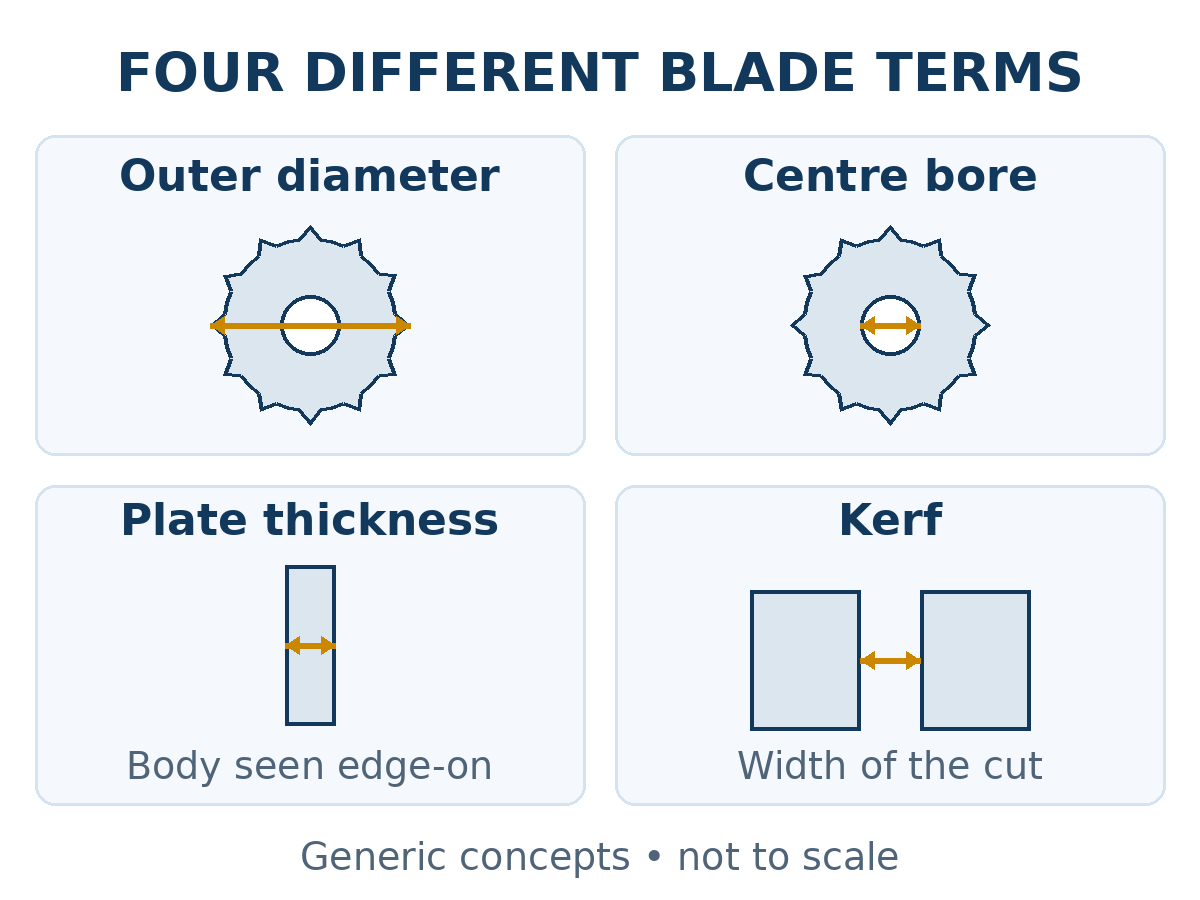
A tooling description should identify the proposed blade and its compatibility with the supplied machine and actual material. Outer diameter, centre bore, blade body thickness and cut width describe different features. Their names do not establish a suitable brass blade, a universal machining allowance or a verified result. Ask the supplier to identify the assessed combination and the workpiece conditions it covers.
Retain the same tooling identity in the cutting observation and quotation. If the demonstrated blade differs from the supplied proposal, request an explanation of the difference and any evidence still required. Do not transfer an aluminum setup into the brass job merely because the generic geometry looks similar.
Choose representative evidence for the purchase decision
Select stock and blank requirements that address the uncertain parts of the proposal. Explain why each sample matters: material identity, section, end condition, length range or a different receiving requirement. A convenient sample can be useful, but its relevance should be stated rather than extended to the whole production schedule.
Agree what will be observed and how it will be recorded against the approved blank requirements. Retain the actual stock identity, drawing revision, machine configuration, tooling information supplied and stated conditions with the result. Separate dimensional observations from end-condition observations and from acceptance by the next operation.
Record time evidence with its scope. A cutting motion, a repeated sequence and a complete order including replenishment and handling are different observations. Request evidence for the production task you intend to compare rather than turning one short demonstration into a guaranteed daily output.
Keep uncertainty visible. If a supplier requires another section drawing, material sample or clarification of the blank requirement, record that request and its effect on the proposal. An unresolved row should not be presented as a failed result, but it also should not be counted as a confirmed capability.
Compare technically confirmed alternatives before assigning value to convenience or projected savings. A low price or a general material claim cannot close a missing blank requirement. Obtain confirmation for the actual job and distinguish measured observations from estimates or future commitments.
Put a time comparison on the same order boundary
For a production comparison, define the start and finish events before collecting time. One useful buyer-defined boundary is the release of the identified stock and job records through to the accepted, identified blanks handed over to the next operation. Within that boundary, distinguish preparation, replenishment, cutting, job changes, receiving and required checks. Record what is actually included rather than assuming each activity is part of a short machine demonstration.
If one reply reports only a repeated cutting sequence and another includes stock changes and receiving, their figures describe different work. Ask for the missing boundary information before ranking them. Use the approved job mix, record the observed duration and note any separately timed or unresolved work. This comparison provides a basis for a purchasing discussion; it does not turn a trial into a guaranteed shift output or establish the capacity of the later machining operation.
Send an inquiry that a supplier can answer against the actual job
Send the incoming-stock specification and approved blank schedule together. Include grade and condition, section drawings, stock lengths, required blank lengths and ends, dimensional requirements, quantities and expected job changes. State the receiving condition needed by the next process and identify information that remains unresolved.
Ask the quotation to identify the machine model and configuration, confirmed families, tooling scope, support and receiving arrangement, purchaser-supplied work, exclusions and the evidence needed for outstanding questions. Include the proposed complete production route in the comparison, without attributing later machining to the saw.
Send Jiurun your brass blank production requirements and request confirmation of applicability for the actual material and parts before selecting equipment. Jiurun’s general industrial nonferrous equipment scope does not establish a result for an unverified brass lot. A useful proposal connects the offered configuration to the defined blank job and makes its limits clear.
See the circular-saw stage in context
This Jiurun video shows a general aluminum cutting-stage context. It is not a brass trial or evidence of the job-mix example above. Request a separate assessment of your actual brass stock, required blanks, tooling and supplied configuration.