
A copper busbar cutting machine should be chosen for the work your factory needs to deliver, not simply for its ability to separate a copper bar. A saw-only station, a shearing station and a combined busbar processing machine cover different operations. The useful purchase is the arrangement that produces the required cut-stage output and fits the remaining manufacturing route.
This guide helps a buyer compare those arrangements for approved copper busbar components. It covers equipment scope, production-flow evidence and a practical quotation comparison. The electrical design, material selection, current rating and final assembly approval must already have responsible owners; choosing a cutting machine does not establish those results.
1. Define the output of a copper busbar cutting machine
First distinguish three deliverables: a straight blank, a component with completed holes or local features, and a formed or finished conductor ready for a specified assembly handover. All three may be described as a busbar in an inquiry, but the machinery needed to produce them can differ substantially. State which one the proposed equipment must deliver.
Use released drawings to describe the part and its required condition at the cutting exit. A straight rectangular blank may still require later hole production, forming, finishing and inspection. A drawing of the final bent component does not automatically provide the blank length needed before forming. Have the responsible manufacturing planner release that input instead of asking the saw supplier to derive it from a photograph.
The European Copper Institute publication introduction identifies busbar-system considerations including temperature rise, short-circuit effects, jointing and maintenance. Those topics explain why a correctly sized cut blank is only one part of the product assessment. This equipment guide does not replace that electrical design work.
Record the entry and exit conditions for the intended purchase. The entry could be identified straight bar stock at a defined rack, while the exit could be counted, accepted blanks in containers allocated to the next operation. If the offer starts after someone has already loaded the stock, or ends before accepted parts are collected, show who performs the omitted work and how it affects the comparison.
2. Release the actual copper input and component records
Give the supplier the specified copper grade, temper, stock form and section dimensions, together with the supplied condition and available material documentation. Do not replace those records with “pure copper” or a photograph of a shiny bar. A machine proposal needs an assessment of the actual input that will arrive in production.
Separate straight solid bar from a laminated or assembled conductor. A layered assembly may have a different supplied state and an approved manufacturing route of its own. Our copper busbar laminate inquiry guide addresses that identity question. Keep it distinct from this comparison of equipment arrangements for released components.
For every blank family, list the stock section, required cut-stage length, measuring reference, both end definitions, quantity and acceptance requirement. Identify finished or protected areas that the process must preserve. If the customer specifies a requirement on the final plated or formed part, assign responsibility for translating it into the appropriate requirement at this earlier stage.
Show the range of work rather than only the easiest or largest section. Include the shorter blanks, longer members and different input sections that matter to your order mix. Ask the supplier to identify conditional or excluded families. A successful assessment of one convenient bar is useful evidence for that task, but it cannot settle a materially different input without review.
Jiurun manufactures industrial circular-saw cutting equipment for aluminum and non-ferrous materials. That company scope is not a configuration-specific confirmation for your copper bar. Request a current response identifying the proposed machine, supplied cutting arrangement and assessed copper job. Do not transfer an aluminum model capacity or feeding repeatability figure into a copper finished-part guarantee.
3. Compare the equipment arrangements on an equal boundary
A saw-only purchase can be a deliberate improvement when an existing factory already has suitable downstream processes. A broader busbar processing purchase can be relevant when those processes are part of the investment. Neither arrangement is automatically preferable. The question is which operations are required, where the present constraint lies and what the offered arrangement actually supplies.
Boschert USA describes separate copper-bar punching and bending equipment as well as a combined arrangement with shearing, punching and bending. This provides a concrete example of different equipment scopes in the market. It is not a Jiurun product specification or evidence that any particular offered configuration covers your drawings.
| Arrangement | Decision it can address | Evidence still needed |
|---|---|---|
| Assessed saw-only station | Producing the agreed cut blanks for an existing downstream route | Actual copper suitability, accepted end condition, collection and remaining operations |
| Assessed shearing station | Separating the agreed stock as one operation in the route | Suitability of the resulting blank for the released drawing and next process |
| Combined processing arrangement | Including several named operations within one proposed purchase | Which features and part families each operation covers, with changes and handling included |
| Separate cutting and downstream stations | Allocating different operations to defined equipment | Transfer, identification, staging and total route capacity |
| Purchased pre-cut blanks | Keeping cut preparation outside the factory investment | Accepted supplied condition, availability and retained internal work |
Ask each bidder to map every required operation to an included item, a separately priced item or buyer-retained work. The words “CNC,” “automatic” and “busbar machine” do not establish that holes, bends, end features or accepted collection are included. Similarly, a combined machine description does not show that all operations can occur simultaneously on your jobs.
For each proposed separation method, obtain a response to the accepted blank condition rather than imposing a universal ranking between sawing and shearing. Require representative evidence where the method affects the subsequent route. If additional end preparation is needed, record that operation and its supplier; a low cutting price is incomplete when essential follow-up work has no owner.
4. Place cutting in the released manufacturing sequence
Draw a simple route from incoming stock to the finished component. Assign an owner to each stage, including any external service. Confirm where the cutting operation receives its instructions, which item it releases and where that item goes next. Keep this route specific to the approved component instead of treating one sequence as correct for every busbar.
If the route includes holes or local features, establish who releases their manufacturing records and at which stage they are made. If it includes forming, establish who releases the flat blank information and how the later geometry is assessed. The saw quote should name its cut-stage responsibility without claiming to solve the other stages through a length setting alone.
Retain the relationship between the final drawing revision and the blank record used at the machine. If the released manufacturing route changes, check whether the existing cutting record still applies before using it for quotation or evidence. A final assembled drawing and an old flat blank program are different documents, even when they carry a similar part name.
Where finishing or surface treatment is required, identify the condition expected at each handover and who confirms it. Do not invent a plating allowance, edge-break dimension or bending correction to make the inquiry look complete. An unresolved manufacturing input should go back to its responsible owner and remain visible until released.
This division also helps evaluate a supplier demonstration. A neatly cut straight piece supports an observation about the demonstrated cutting task. It does not show that the factory can deliver a later formed component, its contact condition or a complete electrically approved assembly. Request evidence only for the operations that the purchase is intended to cover.
5. Check the route constraint before buying faster cutting
Measure the workload at the stages that the investment will affect. Keep accepted quantities separate from items waiting for inspection or work elsewhere. Record a consistent time period and the work included in it. The number of blade actions or separated blanks may be useful for one stage, but it is not the number of finished components available to assembly.
Invented capacity example: a daily order requires 120 released components. In an assessed planning period, the proposed cutting route could release 180 suitable blanks, but the retained downstream feature-making route could release only 100 of the corresponding components, and the retained forming route could release 90 where forming is required. On a simplified route where every component passes through all three stages, output is bounded by the slowest stage at 90 components. The figures are invented and are not Jiurun production claims.
Purchasing still faster cutting does not remove that stated downstream limit. It can increase waiting stock if blank production continues at the faster rate. Before choosing a combined arrangement or separate stations, ask which investment changes the limiting operation and what assessed evidence supports the proposed new result.
Part families can make a single headline rate misleading. If one family needs no forming, it follows a different route from a formed family. Retain quantities and demonstrated time by route instead of adding every job into one apparently comparable number. An unused capacity estimate at one station cannot be transferred to another operation.
Include task changes, stock presentation, collection, checking and the operators actually available during the observation. If a proposal depends on moving a person between stations, record the tasks that person must cover. An automatic feed action does not determine whether the next station receives an operator when needed.
Compare complete arrangements with the same released order mix. If the combined proposal includes operations absent from the saw-only quote, include the retained route in the saw-only alternative. If a combined proposal leaves a particular required feature to another process, keep that process in its comparison too. This makes the investment boundary intelligible without assuming either category is universally more productive.
Track accepted blanks without inflating finished output
Invented order example: family A requires 80 blanks and family B requires 40. Cutting separates 86 A blanks and 44 B blanks. Six A blanks and four B blanks are held pending the agreed checks, leaving 80 A and 40 B released at the cutting handover. The 130 separated pieces therefore represent 120 released blanks at this stage, not 130 accepted finished conductors.
If later processing has completed only 72 A components and 32 B components, the corresponding finished-stage quantity is 104. The remaining released blanks are work in progress. Do not count a held cut blank and a later replacement as two successful components for the same order. Preserve the recorded disposition of held, released and replaced items.
A comparison should state the required order quantity, the accepted handover quantity and the time boundary. Record extra pieces separately so one offer is not credited with more useful order output merely because it produces unnecessary stock. The buyer may have a justified allowance for subsequent work, but that allowance belongs in the released manufacturing plan.
Confirm what the quoted saw actually supplies
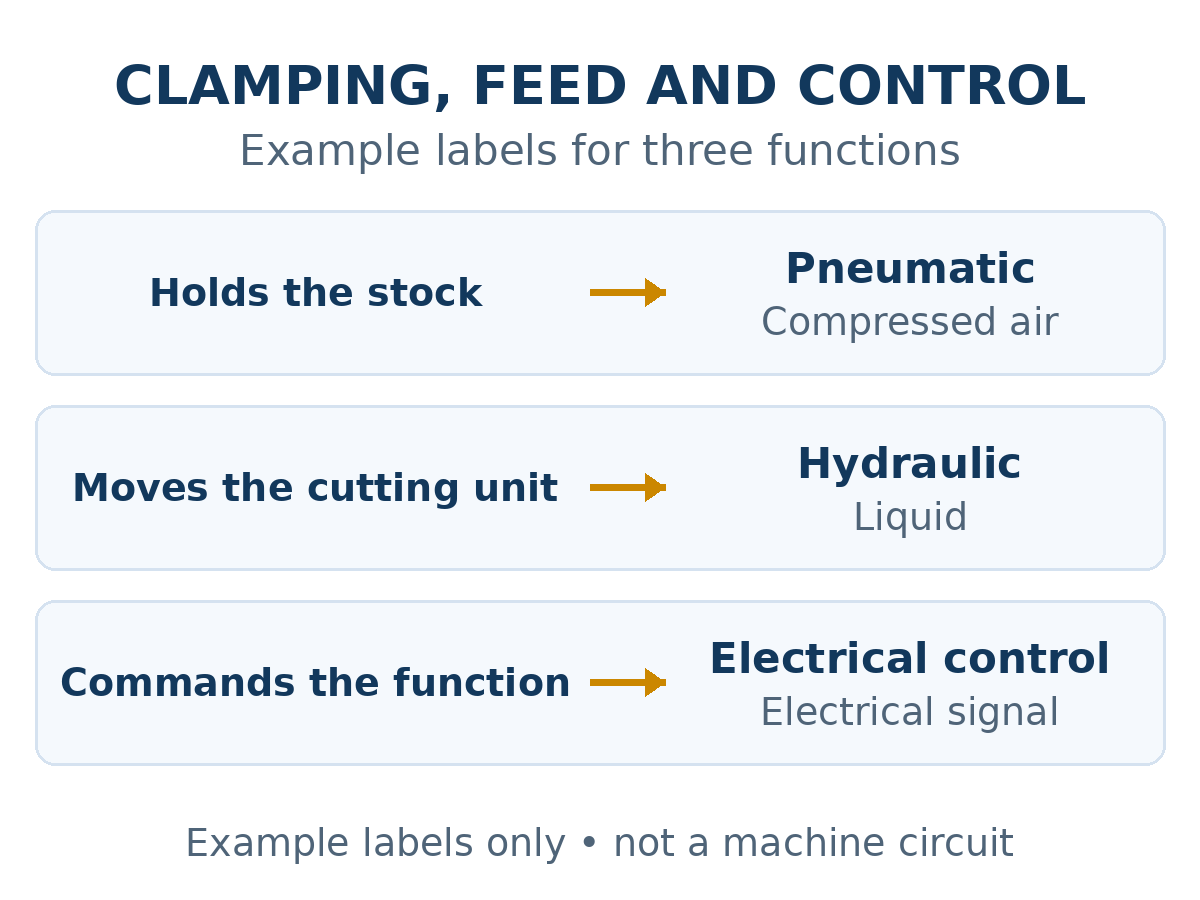
A circular-saw proposal should identify the functions and supplied items used for the assessed copper task. Ask which arrangement holds the stock, moves the cutting unit, positions the blank length and issues the control commands. Function labels describe different responsibilities; they do not prove that automatic loading, every downstream operation or a complete processing cell is included.
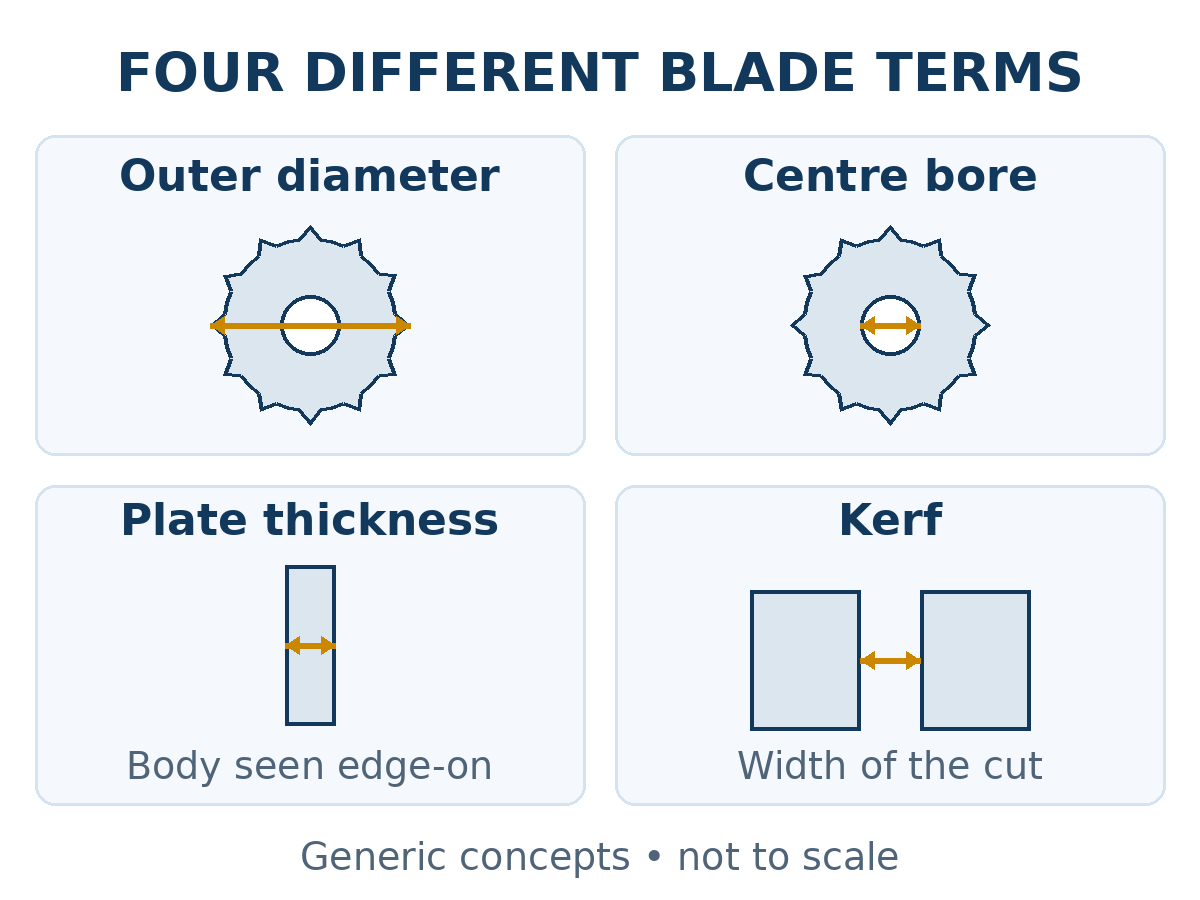
Record the supplied tool identity with the machine proposal. Outer diameter, centre bore, blade-body thickness and kerf are different terms, so a single nominal blade size is an incomplete tool record. Have the responsible supplier confirm the actual tool and its compatibility with the offered configuration and copper input. These identification fields are not a recipe for selecting a blade or changing a machine.
Request evidence that can decide the purchase
Choose representative released jobs that distinguish the alternatives. Include a repeated blank family, a shorter component and a family whose next operation places a particular requirement on the cut-stage condition. Add a complete downstream route only when that route is within the proposed purchase. The selection should expose the scope questions that could change your decision.
Before the assessment, identify the actual stock, offered configuration, cutting arrangement and acceptance method. Obtain an agreed observation boundary covering the relevant work. Record which input families and operations were tested and which remain conditional. Keep the demonstration facts separate from estimated production output.
Ask for the released parts and the observation record, not just a short promotional video. A useful record identifies the component revision, input material, quantities, required checks, accepted results, time boundary and included handling. If the offered tooling or supports differ from those used in the assessment, have the supplier address that difference before treating the result as evidence for the purchase.
Resolve a failure using the observed condition and the agreed acceptance requirement. Do not approve a marginal part because a supplier quotes a positioning number, or reject a whole equipment category on one unexplained sample. The decision needs an assessed route for the required work. If a bidder cannot confirm one component family, keep that exclusion in the commercial comparison.
Compare the complete commercial scope
Build a comparison sheet around the released operations and their handovers. Include the quoted machine, relevant tooling, stock support, collection, programming arrangements, training and the documented scope of any installation or service. Identify buyer-provided items and outside processes. Do not assume an item is included because it appeared in a demonstration or a general workshop image.
Separate initial purchase cost from the operating inputs that differ between assessed arrangements. Use actual supplier quotations and your own production records for those inputs. If a tool-life, staffing or output assumption has no representative basis, label it unresolved rather than turning it into a calculated saving.
Compare the purchased stage and the retained route together. A saw-only station may fit a factory with adequate later-stage capacity; a combined processing arrangement may answer a different investment need. A lower machine price or a broader list of functions alone does not establish the better commercial result for the same released order mix.
Record what would change the decision: confirmation of a conditional stock family, an observed downstream capacity, an included handling item or a revised commercial scope. This makes the next supplier discussion focused. It also avoids requesting repeated generic demonstrations that cannot answer the remaining purchase question.
6. Send a focused copper busbar equipment inquiry
Send the approved component drawings, copper input specification, cut-stage blank records, order quantities and manufacturing routes. State the entry and exit conditions of the proposed investment. Identify which later operations are already available and which must be included in a broader offer.
Ask for a configuration-specific copper suitability response, a map of included and excluded operations, the proposed evidence for unresolved jobs, and a commercial comparison at the agreed handover. A copper busbar cutting machine should have a defined role in that answer. Its name should not obscure the work still required before your components can be released.
Contact Jiurun with your copper stock and required cut-stage blanks for a circular-saw configuration assessment. Include the actual material and component records and explain the downstream route. Copper suitability, trial arrangements, accepted output and the supplied configuration require specific confirmation; no complete busbar processing capability is promised by this article.
See the circular-saw stage in context
This Jiurun equipment video illustrates a cutting-stage context. It is not a copper busbar trial, evidence of the invented output figures, or proof that the shown equipment processes holes, bends or complete conductors. Confirm the configuration and copper task separately.