
Before you order a multi-supplier aluminum saw cell, establish who is supplying the complete job you need, where each quotation stops, and who will provide evidence that the proposed equipment can deliver that job together. Buying a saw from one company and material-handling equipment from another does not, by itself, fill the work between their offers.
The practical choice is between a supplier accepting the complete agreed scope, a separately appointed integrator, and a purchase coordinated by your own team. Any of these routes needs clear deliverables and confirmed boundaries. This guide uses “cell” to describe the work you intend to buy; it does not assign the equipment a legal classification.
Define the job for a multi-supplier aluminum saw cell
Start with the condition of material at the beginning of the purchased work and the condition of parts at its end. Does the scope begin with bundled stock, individually presented profiles, or material already prepared for the saw? Does it end with loose cut pieces, identified batches, or parts released after inspection? These are different purchases even when the equipment list looks similar.
Describe the sections, alloy and temper, stock lengths, cut lengths and angles, batch mix, required output, and finished-part acceptance requirements. Add the intended work location and the people involved. Use the same requirement record for every supplier. For a more detailed description of the entry condition, refer to the aluminum cutting-line material-entry questions.
A useful opening statement is: “We need the proposed scope to take the stated material from this agreed starting condition to this agreed output condition.” Attach the drawings and identify anything still undecided. An unresolved input condition should remain a question, rather than becoming a silent assumption in an order.
Choose a procurement route that covers the missing work
One supplier accepts the complete agreed scope
This route can suit a buyer who wants one commercial contact for the described package. Check whether that supplier actually includes the saw, handling equipment, coordination work, documentation, and evidence for the complete task. A single company name on the quotation is not proof that every item is included.
Ask the supplier to distinguish its own supplied items, subcontracted items, buyer-supplied items, and exclusions. Establish how it will address questions involving another manufacturer. Assess the written scope and supporting evidence before treating the offer as a complete package.
An integrator is appointed separately
This may suit a purchase where equipment offers are already separate and a competent provider is being considered for the combined scope. The integrator’s quotation should identify which coordination and engineering deliverables it accepts, which information it needs from each equipment supplier, and which work remains elsewhere.
An appointment to coordinate purchasing does not automatically establish technical capability or transfer applicable statutory duties. Request confirmation of the actual role and the proposed deliverables. A vague allowance for “integration assistance” leaves too much room for differing expectations.
The buyer coordinates separate suppliers
This route requires your team to manage the interfaces between offers, obtain the necessary competent input, and keep decisions consistent. It may be appropriate when the buyer has the resources and authority to resolve the remaining work. It should not be selected merely because the equipment prices appear lower.
If each supplier accepts only its own machine, record that limitation. Identify who will define, review, supply, and demonstrate the remaining scope. If those tasks have no accepted owner, the combined purchase is incomplete regardless of how attractive the individual quotations look.
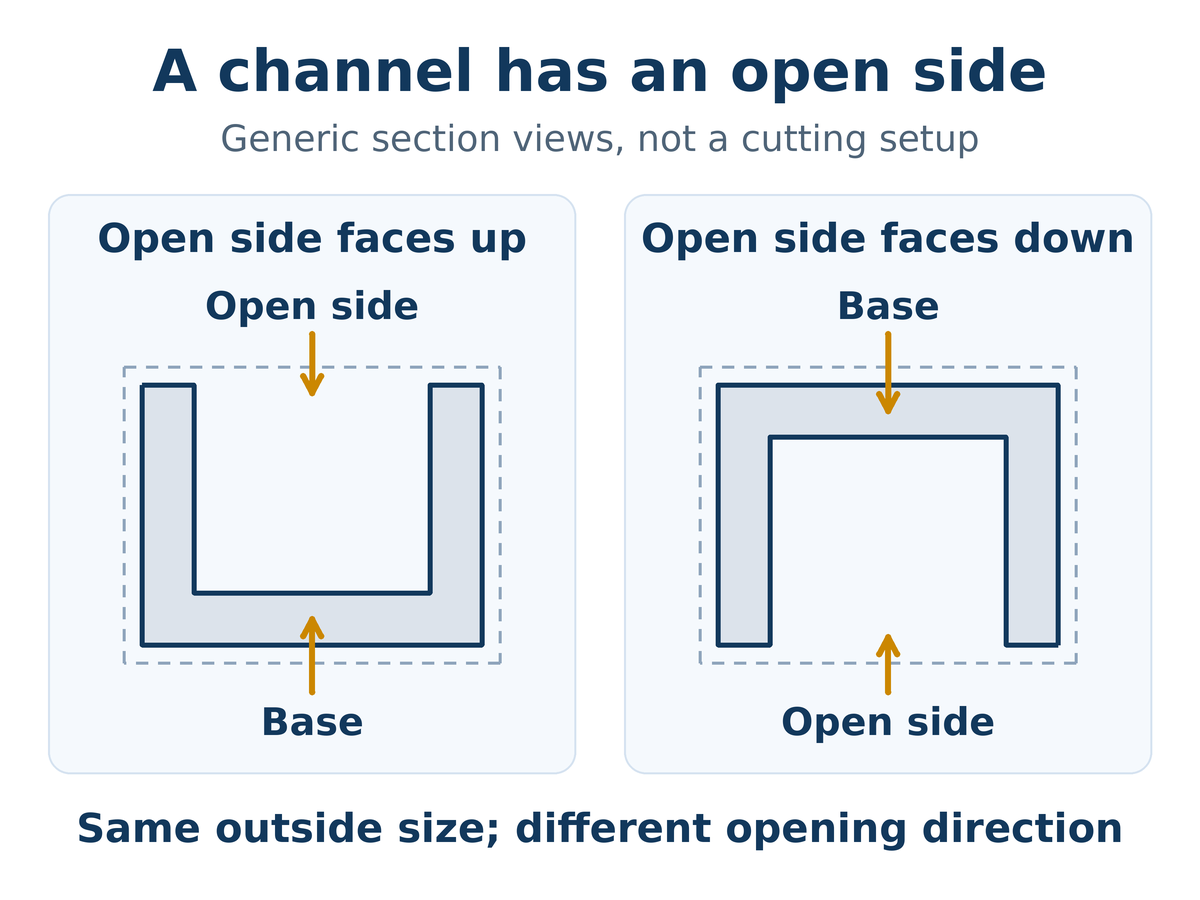
Describe the presentation direction as well as the section dimensions. A channel with its open side facing up and the same channel with its open side facing down can have identical outside dimensions. Send the same labelled view to both suppliers and ask each to identify the condition assumed by its offer. A photograph or generic diagram helps explain the question; the actual drawing and written reply define the proposed requirement.
A hypothetical quotation gap that changes the buying decision
Consider a fictional buyer purchasing a saw and a separate stock-presentation unit. The saw offer assumes that individual profiles arrive in an agreed condition at its input. The handling offer says that it presents stock to a defined delivery point. Both descriptions sound useful, but they do not yet establish that the delivery condition matches the saw’s accepted input.
The buyer also expects cut parts to leave the work as identified batches. The saw offer describes cutting; the handling offer describes incoming stock. Neither offer identifies the receiving and batch-identification work. These are two scope gaps, not evidence that either machine is defective.
The buyer sends both suppliers the same requirement record and asks for explicit replies. One supplier confirms only its own equipment. The other excludes coordination with third-party machines. The purchase can now be evaluated honestly: the buyer needs an additional quoted scope, a provider accepting the complete task, or a revised requirement for independently accepted equipment with a defined handoff.
That last option is a different purchase. It needs its own agreed work method, assessment, and acceptance; it is not an improvised workaround after delivery. This example is hypothetical and provides no evidence of a Jiurun installation, compatible configuration, test result, or supplied integration service.
Build a quotation coverage record around deliverables
Compare all offers against the same rows. For each row, write “included,” “excluded,” or “unresolved,” then cite the offer and revision supporting the entry. Separate the proposed information owner from the party that has actually accepted delivery. The following is an original purchasing worksheet, not a prescribed engineering or legal form.
| Required scope | What to request | What prevents purchase release |
|---|---|---|
| Starting material condition | A shared description of stock presentation and the accepted saw input. | The two offers describe different conditions without an accepted resolution. |
| Work between equipment items | Deliverables defining and confirming the proposed interfaces, with named providers. | Both suppliers exclude the work between their machines. |
| Receiving and output | The output state, collection scope, identification needs, and any inspection boundary. | The equipment list ends at cutting while the requirement includes further work. |
| Configuration and information | Quoted options, referenced drawings, documentation deliverables, and current revisions. | Replies relate to different configurations or unspecified versions. |
| Complete-job evidence | The proposed evidence covering the agreed input, output, and combined scope. | Only separate demonstrations are offered for a combined requirement. |
| Excluded and unpriced work | A record of additional engineering, local work, documentation, or assessment where applicable. | Unpriced work is treated as included or assigned without confirmation. |
A contact name alone does not close a row. The reply must say what that party will supply or confirm and identify the document supporting its commitment. Keep open items visible until an appropriate person accepts their resolution.
Ask what each piece of evidence actually covers
A video of the saw cutting and a separate demonstration of the stock presenter answer questions about their respective demonstrations. They do not automatically establish performance of the proposed combined task. Ask what material, equipment configuration, input condition, output condition, and work boundaries each piece of evidence covers.
If a supplier refers to a previous project, establish which parts of that evidence apply to your proposed purchase and which do not. A similar machine appearance or model name is insufficient to settle those questions. Record limitations instead of describing the evidence as a complete match.
Agree what further evidence is needed and who is expected to provide it. This guide does not specify test procedures, control logic, wiring, guards, or safety-system design. The purchasing record organizes questions; the relevant technical and site assessments need competent input for the actual equipment and location.
The UK HSE work-equipment FAQ advises purchasers to consider intended use, users, location, and risks, and to discuss complex requirements with suppliers. It distinguishes installing complete supplied equipment from building equipment using parts from several manufacturers. This is a UK reference; the distinction does not establish the legal role or requirements for your proposed cell.
Compare complete scope before comparing total price
Keep the equipment prices separate from other required work until the offers establish what is included. Add engineering, local work, documentation, assessment, and other relevant items only on the basis of their actual quoted scope. Mark anything unquoted as unknown. An unknown amount is not zero.
The purpose is to compare offers for the same result. One offer may cover a complete agreed task, while another covers only independently supplied equipment. Their totals cannot be interpreted as alternative prices for an identical purchase until the differences are resolved.
Record the commercial treatment of unresolved work before placing an order: who will obtain the quotation, who can approve it, and whether the equipment decision depends on that reply. Do not claim a saving, shorter delivery, lower staffing requirement, or productivity increase from the procurement route alone.

Send an RFQ pack that exposes the boundaries
Use your normal aluminum cutting-machine RFQ information, then add a short cross-supplier scope record. Each provider should receive the same current requirement and know which other offers are being considered.
- Workpiece and job: section drawings, alloy and temper, stock condition, cut lengths and angles, batch mix, required output, and finished-part acceptance criteria.
- Scope limits: the agreed starting and ending conditions, buyer-supplied equipment, required receiving work, and explicitly excluded tasks.
- Offer references: supplier names, quotation references, revisions, options, assumptions, and documentation lists.
- Coordination deliverables: who proposes each interface definition, who confirms it, who supplies the agreed work, and what remains unassigned.
- Evidence and open items: evidence offered for the complete task, known limitations, requested clarification, and the person authorized to approve the purchase scope.
Invite suppliers to challenge inconsistent assumptions. A specific exclusion can be more useful than an ambiguous promise because it identifies work that still needs a decision. Preserve those replies with the offer they qualify.
A copyable cross-supplier clarification sheet
Use one sheet for a defined purchase, attach the current requirement revision, and obtain a separate reply from each provider. The entries below are prompts rather than predetermined answers. Leave an unresolved entry open instead of filling it with an assumption.
| Shared question | Provider reply to record | Buyer decision |
|---|---|---|
| Which requirement revision prices this offer? | Document reference, drawing revision and exceptions. | Confirm all providers are answering the same job. |
| What arrives at your scope boundary? | Material condition, section orientation, delivery point and preparation assumed. | Match the preceding provider’s stated output. |
| What leaves your supplied scope? | Part condition, receiving arrangement and identification included or excluded. | Compare it with the required end condition. |
| Which work involves another provider? | Specific deliverables accepted, excluded or awaiting clarification. | Obtain an accepted provider for each required task. |
| What evidence supports the proposed combined task? | Material, configuration, boundaries, limitations and evidence still to be supplied. | Decide whether additional confirmation is needed before release. |
| Which costs and commitments remain open? | Unpriced scope, dependencies, revision responsibility and expected reply. | Keep the affected purchase decision open. |
When answers conflict, send the specific conflicting statements back to the relevant providers. Ask for a revised reply tied to the shared requirement, then record the decision and its reference. Do not simply choose the more reassuring statement. For example, if one offer excludes receiving equipment while another assumes that receiving is supplied by the buyer, that work is still missing until someone explicitly accepts it. A completed sheet is useful only when its answers describe the offer you intend to order.
Release the order only for the scope you can identify
Before ordering, review three questions together: Does every required deliverable have an accepted provider? Do the suppliers’ input and output assumptions describe the same proposed task? Is the evidence plan appropriate to that task and its stated configuration?
If a gap remains, keep the affected purchase decision open. Request a revised offer, obtain a separately quoted coordination scope, or change the requirement explicitly. Purchasing unrelated equipment and expecting the missing work to be resolved on arrival leaves the decision unfinished.
When a later offer revision changes a boundary, check which earlier confirmations are affected. The important record is the scope accepted for the current order, not a collection of reassuring replies about superseded arrangements.
Jiurun manufactures industrial aluminum and nonferrous-metal circular-saw equipment. To discuss the saw portion of your proposed purchase, review the aluminum cutting-machine range and send your drawings and scope questions. Ask which equipment and services are included in the specific offer; this article does not promise a turnkey cell or compatibility with another supplier’s equipment.
See an aluminum-saw example, then check your quoted scope
This Jiurun video illustrates the equipment shown in that recording. It does not prove compatibility with a separate stock presenter, an agreed complete-cell scope, or performance for your material. Use it to frame questions, then request evidence matching the proposed configuration.