
Specify aluminum tube miter clocking as the required relationship around the tube between a sloping end and a named side feature. Decide whether that feature arrives at the saw already made or will be added afterward. The purchase must cover where the relationship is established, not only the finished length and miter angle.
Aluminum tube miter clocking is a separate relationship
Clocking here means orientation around the tube’s long axis. It is separate from the slot’s position along the length and from the inclination of the end cut. Two parts can have the same tube size, length and miter angle while the slot occupies a different circumferential position relative to the sloping end.
Hypothetical production case: an assembly needs an ordinary aluminum round tube with a mitered end and a side locating slot. Its approved drawing defines their relationship. Route A starts with plain tube; Route B starts with the slot already present. Both routes seek the same finished part. No actual customer, trial or JiurunCut configuration is described.
Label the mitered end End A on the drawing and define a view looking along the axis toward the opposite end. Relate the slot reference to the miter’s long-point side if that is the reference used in the approved drawing. Keep both references in the same view; this does not specify a machine setup. A description such as slot on the right is incomplete without that viewing basis.
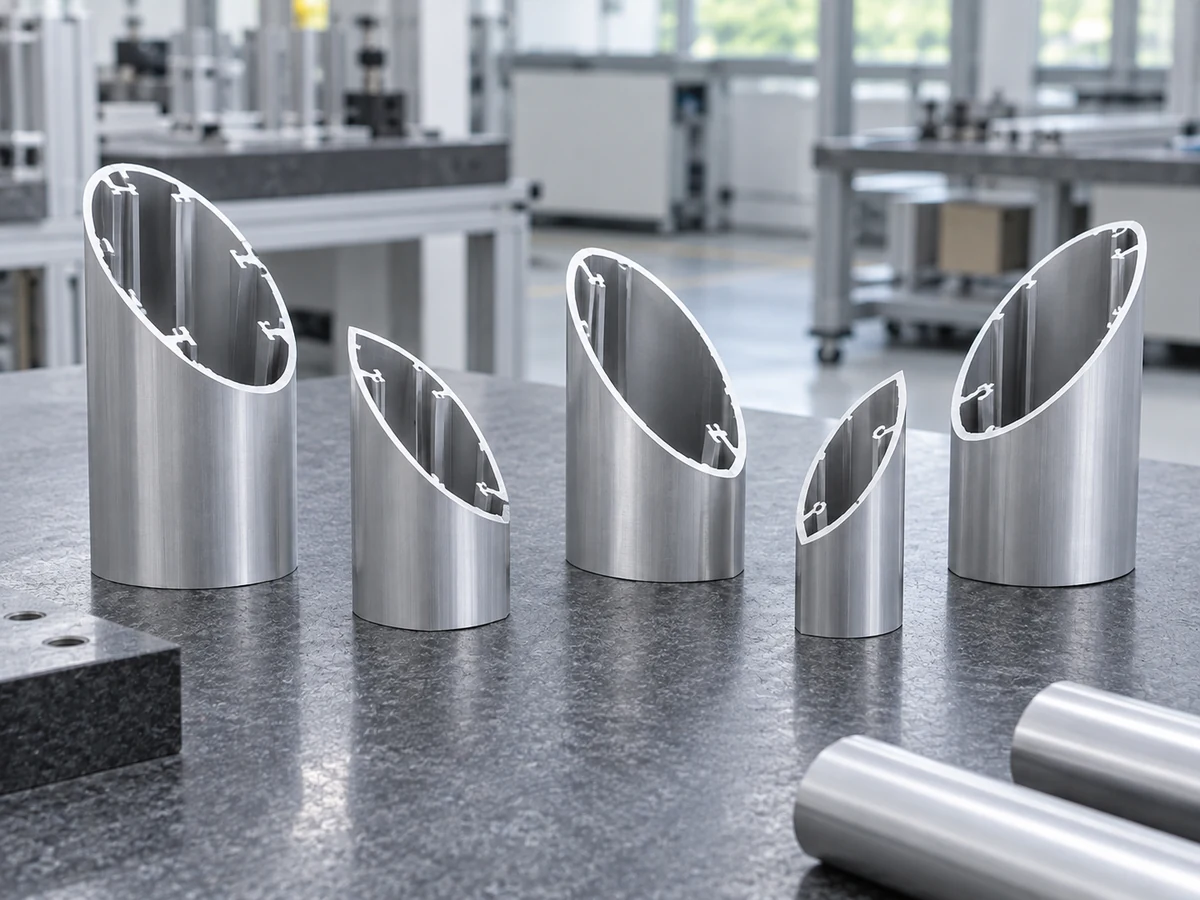
BLM GROUP’s January 2022 article discusses consistent initial angular orientation of round tubes in its laser-processing and bending context. It illustrates orientation as a distinct process concern; it does not establish how a circular saw handles the buyer’s part or identify a JiurunCut function.
Decide whether the slot exists before cutting
Route A: plain tube, then miter, then slot. At the saw stage there is no existing slot against which to register the cut. The downstream feature-making operation must place the new slot in the required relationship to the actual mitered end. Supplying the slot dimensions independently of that end would leave the assembly relationship unresolved.
The buyer should confirm that the downstream provider accepts the proposed saw-cut input and includes establishing this relationship in its work. That does not approve any saw for the task or mean later machining can correct an unacceptable earlier cut. Each supplied stage still has its own requirements.
Route B: slotted tube, then miter. The feature is already part of the incoming workpiece. The cutting proposal must therefore address how its finished miter relates to that feature. An answer confirming only an angle and length leaves the additional relationship unanswered.
Buying pre-slotted material may remove slot-making from the buyer’s later work, but it moves the relationship question into the cutting stage. Do not treat that upstream preparation as evidence that an ordinary miter-cutting cycle already covers the complete part.
Compare routes against the required assembly relationship
Keep the same finished drawing across the route comparison. The practical difference is which operation creates the relationship and what the next provider receives, not whether one proposal uses a more advanced-sounding machine label.
| Incoming part / route | Where the cut-to-feature relationship is established | Purchasing consequence |
|---|---|---|
| A — Plain tube; slot added after the miter | In the downstream operation that forms the slot relative to the supplied mitered end. | Confirm the accepted saw output and the remaining feature-making scope. Separate length and slot specifications must still describe one finished relationship. |
| B — Existing side slot; miter added later | In the cutting route relative to the incoming slot, subject to supplier assessment. | An angle-and-length offer alone is incomplete for this requirement. Request a response covering the existing feature and the required end orientation together. |
| Both features purchased within one finished-part route | Within the explicitly proposed combined supply, if a provider offers it. | Compare the delivered relationship and any excluded work. Do not presume a single machine or a particular process performs both operations. |
In the fictional case, an alternative part could match the specified length and miter angle yet place the slot differently around the tube. When its miter is represented in the required assembly orientation, that slot does not occupy the requested position. This is a geometric comparison, not a reported assembly failure or a tolerance assessment.
A combined finished-part supply is another option to investigate when the buyer does not want to coordinate the two stages. It is not a claim that JiurunCut or either cited product supplies that route. Confirm the actual provider and output rather than assigning the missing operation by assumption.
Ask for the offered route, not an assumed rotary feature
BLM GROUP’s SMART tube-bender page describes hole-search and automatic tube-orientation functions, and identifies holes and slots among detectable features. This is a feature-based orientation example on its bending equipment, not evidence of recognition or registration on any JiurunCut saw.
Both cited pages belong to BLM GROUP. They are not independent tests, and neither provides an application assessment for the fictional aluminum part. Do not convert their descriptions into a requirement to buy a camera, rotary axis or particular fixture.
A buyer can instead ask:
Please distinguish plain-tube input from input already carrying the specified slot. Identify where your proposed route establishes the miter-to-slot relationship on our approved drawing. If you supply only the mitered blank, state the feature-making work left downstream. If you cut the slotted input, address that relationship rather than confirming angle and length alone.
Supporting evidence should concern the same incoming state and finished relationship. A sample showing a satisfactory miter without the relevant slot does not answer Route B. Missing evidence leaves that scope pending; it does not prove the supplier cannot offer an appropriate arrangement.

If plain tube has no relevant circumferential feature and the approved design requires no such relationship, do not add clocking merely because it appears in this article.
Send the incoming tube and the finished relationship
Share the actual aluminum tube, whether its side feature already exists, and the approved relationship to the mitered end. Identify any downstream feature-making work already assigned.
Contact Jiurun About the Required Cutting Scope
Ask what can be assessed for the specific proposal. JiurunCut’s feature recognition, circumferential registration, slot-making and suitability for this part remain unverified; this article promises none of them.