
Aluminum cut list optimization arranges required parts across available stock while respecting the actual cutting constraints. It can change which lengths share a bar without changing the finished-part dimensions on the drawing.
This guide uses a small, invented straight-cut order to show why cutting every length group separately can consume more stock than mixing compatible lengths. Then it explains three pattern checks to complete before releasing a real job.
On this page
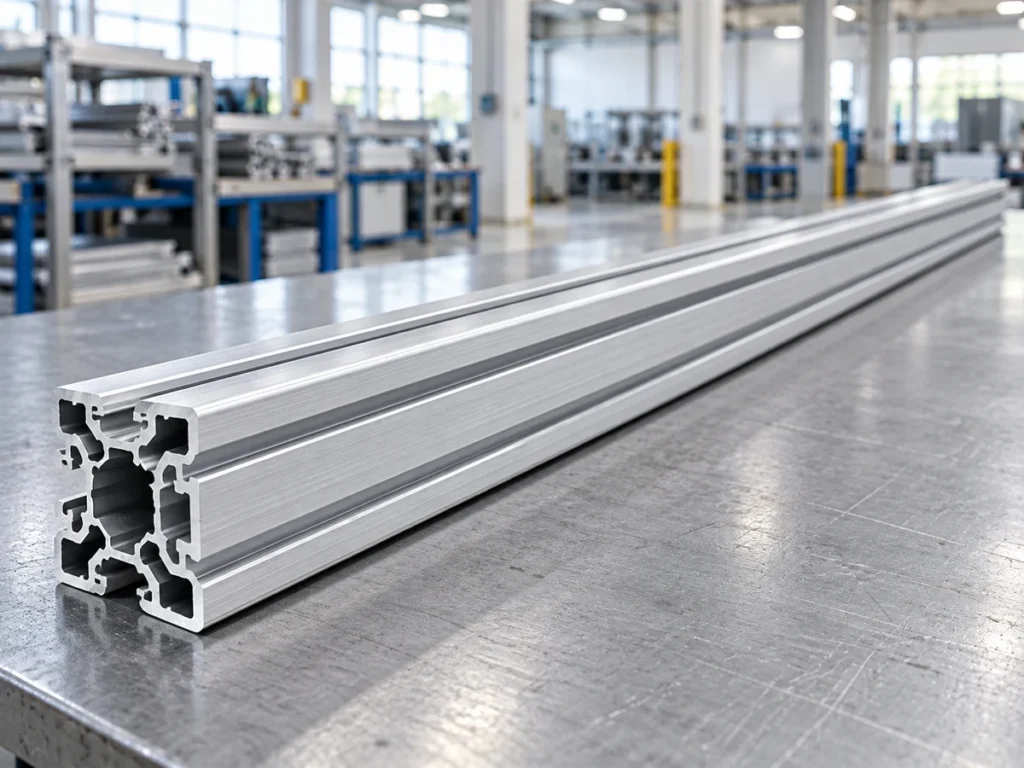
Aluminum cut list optimization: an invented four-part order
Assume all four pieces use the same approved profile, material and finish. The order requires two pieces at 3,100 mm and two at 2,700 mm. Every piece is a straight-cut part measured from the same agreed length datum.
Each stock bar starts at an assumed 6,000 mm. A total 20 mm is consumed by front preparation, including its associated cutting loss. Each finished piece then has one separating cut with an assumed 4 mm kerf.
The plan must leave at least 100 mm after the last production cut. That is an invented reserve, not a machine specification. The example includes no extra end preparation, angle cuts or other exclusion zones.
| Assumed input | Example value |
|---|---|
| Stock per bar | 6,000 mm |
| Total front-preparation loss | 20 mm, including its cut loss |
| Required pieces | 2 × 3,100 mm and 2 × 2,700 mm |
| Production kerf | 4 mm for each separating cut |
| Required remaining length | At least 100 mm |
After preparation, each bar has 6,000 − 20 = 5,980 mm remaining. Protecting the assumed reserve leaves 5,980 − 100 = 5,880 mm for finished pieces and production kerfs.
Keeping the two length groups separate uses three bars
Two 3,100 mm parts cannot share one bar in this model. They need 3,100 + 3,100 + 8 = 6,208 mm for their lengths and two production kerfs, exceeding the 5,880 mm budget.
Producing the two long parts separately therefore uses two bars. Each has 5,980 − 3,100 − 4 = 2,876 mm left after its production cut.
If both 2,700 mm parts are then assigned to a third bar, they consume 2,700 + 2,700 + 8 = 5,408 mm. That bar has 572 mm left, which meets the assumed reserve.
This arrangement fulfills all four pieces using three bars. It leaves long tails on the first two bars because the plan never considered mixing the lengths.
Mixing one long and one short part uses two bars
Place one 3,100 mm piece and one 2,700 mm piece on each bar. Their combined consumption is 3,100 + 2,700 + 8 = 5,808 mm, including the two production kerfs.
Each bar then leaves 5,980 − 5,808 = 172 mm. That exceeds the assumed 100 mm reserve. Repeat the pattern on a second bar to complete the order.
The full length balance for each mixed bar is 20 + 3,100 + 2,700 + 8 + 172 = 6,000 mm. The 100 mm reserve is already within the 172 mm remainder; adding it again would count it twice.
| Arrangement | Result under these assumptions |
|---|---|
| Separate length groups | Three bars: one long part on each of two bars, then both short parts on a third. |
| Mixed lengths | Two bars: one long and one short part on each, with 172 mm remaining per bar. |
The required finished lengths total 11,600 mm, so one prepared bar cannot complete the order. The valid two-bar pattern therefore reaches the minimum bar count for this small model. This is arithmetic for invented inputs, not a promised stock reduction on another job.
Three pattern checks before releasing a real job
1. Check that the pieces may share stock
Group parts by the approved profile and material identity. Include finish, batch restrictions and any order requirement that prevents substitution. Equal length alone does not make two profiles interchangeable.
2. Check that every proposed bar fits the process
Confirm the supplied length, preparation losses, actual cut count and required remaining length for the offered setup. Include any additional restrictions absent from this model. A length balance is only one part of reviewing a usable cutting pattern.
3. Check that all required parts are still present
Count the completed quantities by part reference and drawing revision. Look for missing pieces, duplicated rows or an unapproved change to the finished dimension. Keep the approved pattern with the controlled cut-list revision.
What an optimizer still needs from you
Boole & Partners describes OptiCut as software for panel and bar cutting optimization, with stock and recoverable-offcut handling. Such functions can support planning, but the inputs must describe the job being ordered.
Its published OptiCut V tutorial illustrates material grouping, section symmetries and angle-matching considerations. It also notes that favoring reusable offcuts can increase the required bar count. Those are useful review topics; this guide does not establish current software compatibility with a JiurunCut controller.
Agree the planning objective before comparing outputs. Fewest new bars, useful remaining stock and a manageable production sequence are different questions. Ask the planner to identify which objective the submitted pattern answers.
Questions buyers ask
Should the longest pieces always be cut first?
This example shows why a length-group-only arrangement can miss a useful combination. Review complete patterns against the actual order and process constraints rather than applying one sequence rule to every job.
Can I add the example’s 4 mm kerf to the controller setting?
The value belongs only to this stock-planning model. Confirm the approved controller’s compensation method and setup instructions before entering production values.
Is every remaining length a reusable offcut?
Record its identity, condition and usable length, then review it for a later job. A remainder that satisfies the current pattern’s reserve is not automatically suitable for another setup.
Does the example apply to mitered pieces?
It covers straight cuts only. Angled parts require their actual measurement references, orientation and cut sequence in a separately reviewed pattern.