
Buying aluminum machine guarding frames starts with a clear supply boundary. Are you ordering cut members, an assembled frame, a panel-and-door package, or a complete guarding system? The answer changes the drawing set, quotation, delivery checks and responsible parties.
A cutting specification can control the frame parts. It cannot establish that the completed guard protects people from the machine. The responsible machine or safety designer must define the protective requirements and approve the complete installation.
On this page
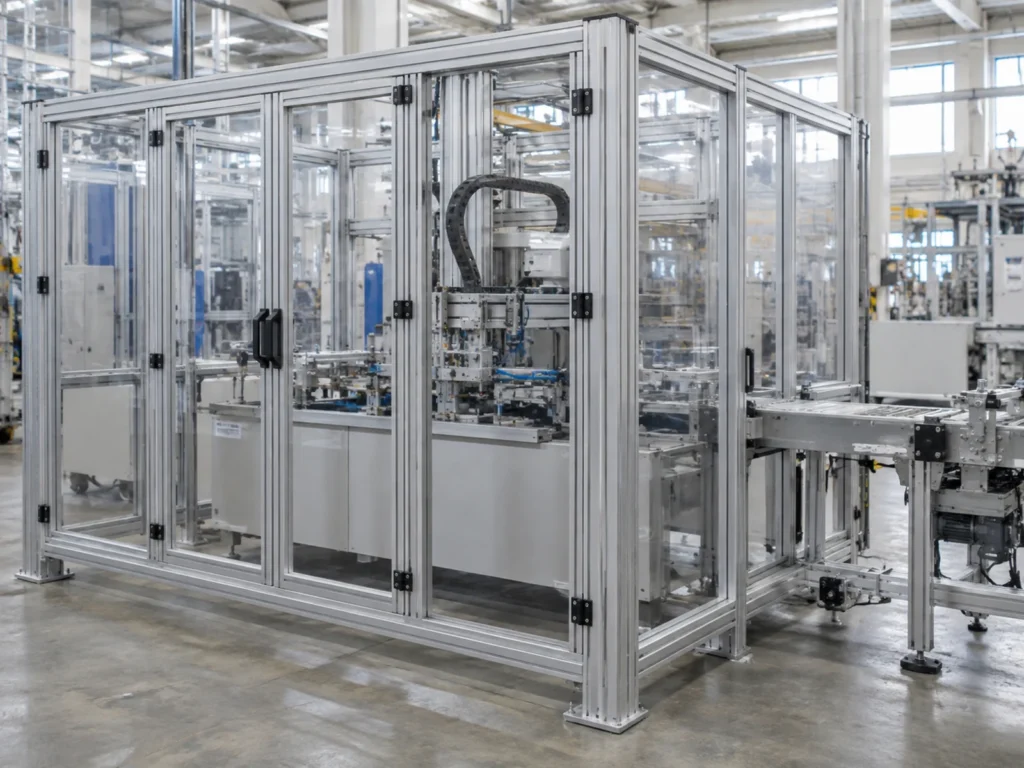
1. Define the package for aluminum machine guarding frames
The phrase “guard frame” can describe very different orders. Put the delivery package on the first page of the RFQ so that each supplier prices the same work.
- Cut members: identified aluminum lengths, with specified end preparation and packaging.
- Frame kit: members plus an agreed list of connectors and other hardware, supplied for assembly.
- Assembled frame: connected frame sections, with the extent of panels and doors explicitly stated.
- Complete guarding package: the agreed mechanical components and any specified safety-related integration, with named design and validation responsibilities.
Do not infer the fourth package from the first three. A quotation for profiles and brackets may exclude panels, mounting, controls and commissioning. Ask for an inclusion-and-exclusion list rather than relying on the product name.
For context, 80/20’s guarding overview describes applications that include guards, enclosures and visual barriers. It also discusses maintenance access and different assembly delivery options. Those distinctions help buyers describe the package they need; the supplier’s offerings are not a specification for your installation.
A useful scope sentence
“Quote the released frame-member kit and listed connectors only. Panels, doors, site mounting, safety controls and complete-system validation are by the named integrator unless individually included in the quotation.”
This is an editable procurement example, not a recommended safety architecture. Replace the exclusions with the actual project assignments.
2. Identify members by function and orientation
A frame may contain uprights, horizontal rails, door members and removable sections that share an outside profile size. That does not make the parts interchangeable.
Give each part a unique identity tied to its drawing revision. Include the profile system, section reference, finished length, end condition and any secondary features. Mark which face carries the panel, hinge or connector so that machining is not mirrored unintentionally.
For repeating bays, use an assembly reference as well as the part number. A rail for a fixed bay and a rail beside an access door can look similar while having different mounting details. Labels should preserve that distinction through packing and assembly.
Our aluminum frame-kit guide explains how to keep members and assembly groups traceable. The guarding RFQ adds another requirement: changes to these parts must remain connected to the approved system design.
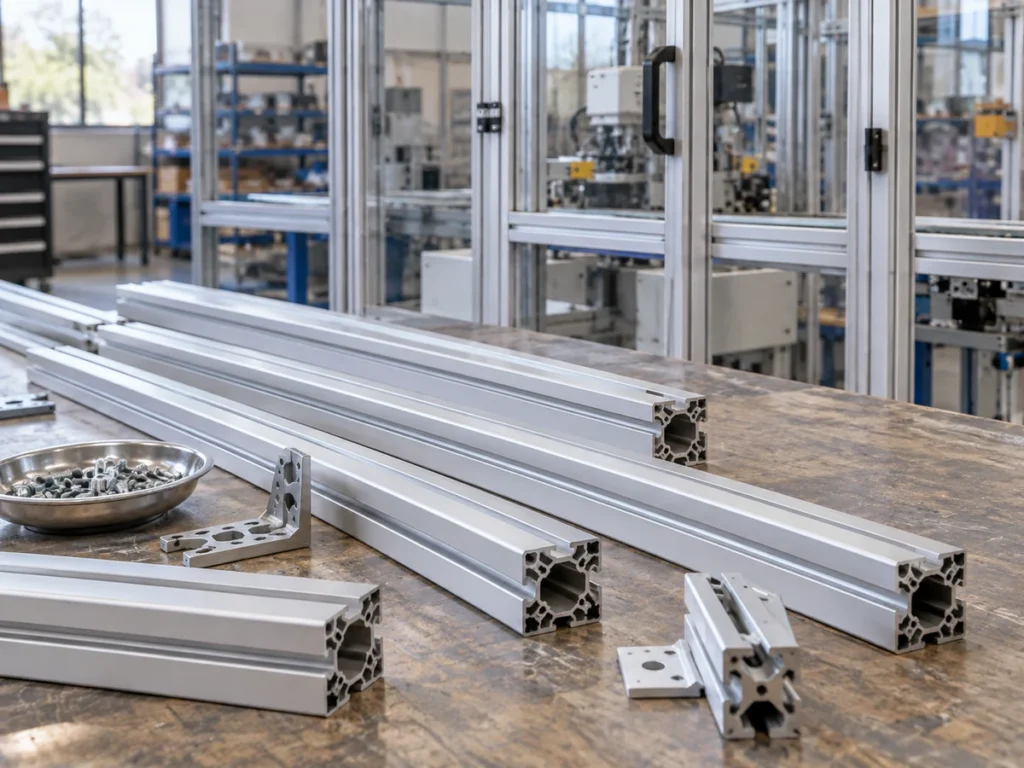
3. Release panel, door and mounting interfaces
Ask the designer for the interfaces that affect frame preparation. These may include panel retention, door hinges, latches, cable routing and attachment to the surrounding structure. Identify the released drawing for each interface rather than asking the cutting supplier to choose it.
For a panel interface, distinguish the panel’s overall outline from the frame member’s cut length. The supplier should know which dimension belongs to which component. Do not assume that a panel size equals the distance between two profile ends.
For an access door, record the door assembly identity and its hardware references. Confirm whether the quote includes the door frame, panel, hinges, handle and any specified sensing components. A handle visible in a picture does not show how a safety-related function is implemented.
The item enclosure and guard system overview distinguishes machine safety guards from industrial partitions used for visual separation or privacy. A similar appearance should not be treated as an equivalent purpose.
When profiles come from different systems, verify the exact connector and slot references. Our T-slot compatibility guide helps structure that component check. It does not validate a protective assembly.
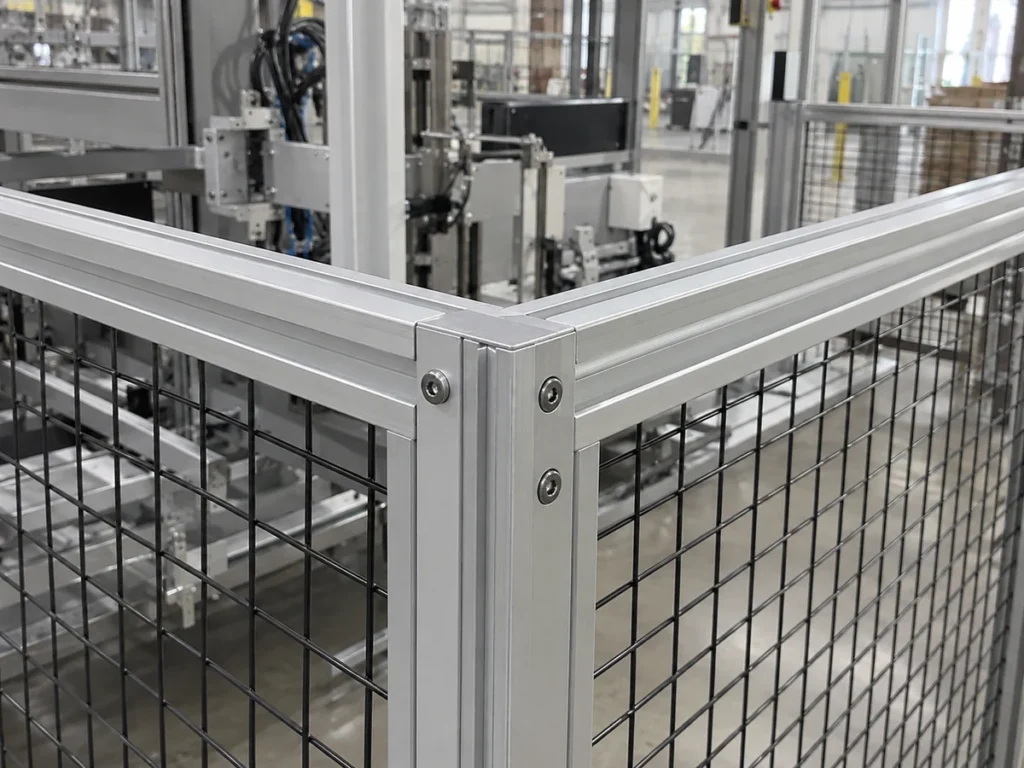
4. Separate factory assembly from site work
A frame that fits on an inspection bench can still require substantial site coordination. State the shipping configuration and what the installer must complete after unpacking.
Useful quotation questions include:
- Will the order arrive as loose members, individual bays or larger assembled sections?
- Which fasteners and panel-retention components are included?
- Which labels remain visible after assembly?
- Who confirms the actual machine and installation interfaces?
- Who reviews substitutions or site changes before use?
These are allocation questions, not instructions for locating a guard or sizing its supports. Protective distances, openings, loads, anchorage and safety functions belong to the responsible designer’s requirements.
Use an approved installation drawing to avoid a common handoff problem: the frame supplier measures its own assembly, while the installer assumes those dimensions also define the machine envelope. Keep the frame references and site references visible as separate fields.
Handle a proposed change through the drawing
If a supplier proposes a different connector or panel-retention method, request an identified change and revised scope. The project owner should route it to the responsible designer. Do not accept “fits the same slot” as approval for the complete guarding function.
5. Match acceptance evidence to responsibility
For a cut-member order, incoming checks can address identity, quantity, dimensions, end condition and specified preparation. Use the agreed measurement method and acceptance limits from the released documents.
For an assembled-frame order, identify the additional checks the supplier actually performs. A dimensional report should name the assembly, revision and reference points. Photographs can document appearance and packing, but they do not replace the agreed inspection record.
For the complete installation, obtain the evidence required by the responsible machine or safety designer. A member-length report is only evidence about the measured members. Keep it separate from the complete-system assessment and release.
The first-article inspection guide can help organize the part evidence. Add a responsibility field so the buyer knows who checks each item and who authorizes final use.
A concise RFQ cover note
- Purpose: identify the machine or area and the released guarding design reference.
- Supply: state the delivery package and list included and excluded components.
- Parts: attach the member list, profile references, drawings and revisions.
- Interfaces: name the panel, door, mounting and integration documents.
- Release: assign supplier inspection, site assembly and complete-system validation to named parties.
This cover note helps align quotations. It does not replace the engineering documents or approval process.
Buyer questions
Does accurate cutting make a frame a compliant machine guard?
No. Accurate members can satisfy their part specification. Protective performance depends on the complete design and installation, including its agreed components and safety functions. The responsible designer must define and validate those requirements.
Can I use a photo to specify a guarding frame?
Use it to communicate general appearance. Order from released drawings and a component list. A photo cannot reliably establish member dimensions, panel material, hardware identity or the safety-related arrangement.
Should I buy the frame and panels separately?
Either procurement route needs clear interfaces and responsibility. Separate orders require coordinated documents; a combined order still needs an explicit scope. Choose the route that your project team can inspect, assemble and approve consistently.
What should I send for an aluminum cutting review?
Send representative profile drawings, the member list, required finished lengths, end preparation, material condition and batch quantities. Keep the complete guarding design reference attached so that proposed manufacturing changes can be reviewed in context.
Prepare the frame-member cutting review
Contact JiurunCut with your released member drawings and production requirements to discuss the aluminum cutting stage. Identify whether the work concerns loose members or a frame kit. Complete guarding design, integration and validation responsibilities should remain explicit throughout the project.